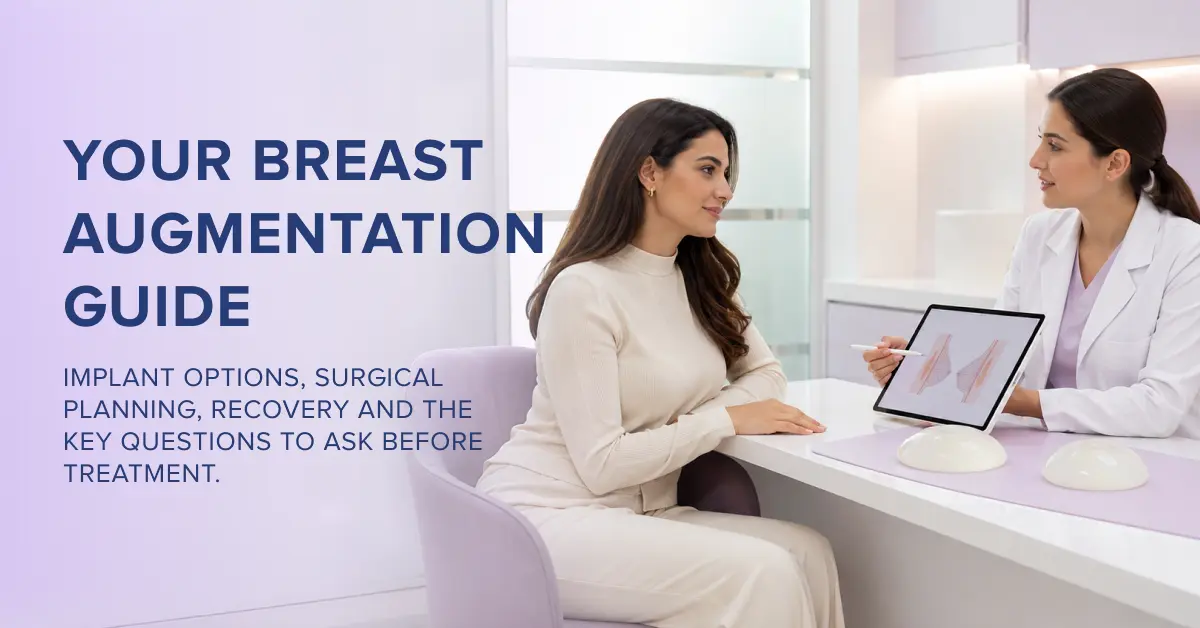

Breast Augmentation in Turkey: Procedure, Implants, Recovery and What to Know

Breast augmentation is one of the most commonly researched cosmetic procedures for patients travelling to Turkey. This guide explains what breast augmentation involves, how implants are chosen and placed, what the surgery and recovery are realistically like, and what international patients should know before travelling — including how to plan their stay, evaluate a surgeon and clinic, and set realistic expectations. It is written to inform your decision, not to sell surgery.
Breast Augmentation in Turkey: Procedure, Implants, Recovery and What to Know

Table of Contents

Dr. Placeholder Name
Medically Reviewed
Reviewed by Dr. Placeholder Name — Board-Certified Plastic Surgeon

Get a Free Breast Augmentation Consultation

Talk to an experienced patient coordinator about your breast augmentation in Turkey.
Please enter a valid phone number.

Key Takeaways

  • Breast augmentation increases breast volume and can improve proportion, most commonly using breast implants (and, in selected patients, fat transfer).

  • Implant choice — size, shape, profile and placement — should be based on your anatomy, goals and the surgeon’s assessment, not on cup size alone.

  • The same implant volume can look different on different bodies, so results are individual and “natural” is subjective.

  • Recovery takes time and involves activity restrictions; swelling settles gradually and the final shape appears over a few months.

  • International patients need to plan their stay, follow-up and travel home around the surgeon’s advice, not a fixed number of days.

  • Package inclusions, risks and results vary between individuals and providers — always request an itemised written plan and quotation.

What Is Breast Augmentation in Turkey?

Breast augmentation in Turkey is a surgical procedure used to increase breast volume and improve breast proportions, most commonly using breast implants. It is carried out by a plastic surgeon under general anaesthesia, and the plan — implant type and size, where the implant is placed and where the incision is made — is tailored to the individual at consultation. Turkey is a common destination for the procedure because many clinics regularly treat international patients and offer package-based care.

At a high level, the process involves selecting an implant suited to your body and goals, creating a pocket for it either above or below the chest muscle, placing the implant through a small incision, and then a recovery period during which swelling settles and the final shape emerges. Suitability, implant choice and outcome all depend on individual anatomy, so a thorough consultation is essential before any surgery is planned.

Breast augmentation procedure overview showing consultation, implant selection, surgery and recovery in Turkey.

Why Do Patients Choose Breast Augmentation?

Patients choose breast augmentation for different personal reasons, most often to increase breast volume or improve balance and proportion. There is no single “right” reason, and the procedure is a personal choice rather than a medical necessity for normal anatomical variation.

Common reasons include:

  • Increasing breast volume

  • Improving breast proportions relative to the body

  • Restoring volume lost after pregnancy, breastfeeding or weight change

  • Improving a noticeable difference in size between the breasts

  • Changing breast shape within realistic anatomical limits

A good surgeon will discuss what is realistically achievable for your body rather than promising a specific look. Breast augmentation adds volume and can refine shape; it does not, on its own, lift significantly sagging breasts — a point covered later in this guide.

Who May Consider Breast Augmentation?

Breast augmentation may be considered by adults in good general health who have realistic expectations and want to change breast volume or proportion.

Suitability is always decided at an individual consultation, but a surgeon typically considers:

  • General health and fitness for surgery and anaesthesia

  • Breast and chest anatomy, including tissue and skin characteristics

  • Realistic expectations about what surgery can achieve

  • Medical history, including any breast concerns

  • Smoking status, since nicotine can impair healing

  • Any previous breast surgery

  • Ability to follow aftercare and attend follow-up

There is no single universal eligibility rule. A responsible surgeon will also decline or delay surgery where expectations are unrealistic or where it is not in the patient’s interest, and will discuss stopping smoking well before the procedure.

Breast Implants vs Fat Transfer: What Is the Difference?

Breast augmentation can be performed using implants or, in selected patients, using the patient’s own transferred fat — and the appropriate approach depends on anatomy, goals and clinical assessment. The two methods work differently and suit different situations. Neither is universally better.

At a high level:

  • Implants add a defined, more predictable volume and can achieve a larger increase in a single procedure. They are medical devices placed in a pocket in the breast.

  • Fat transfer uses liposuction to take fat from another area of the body and inject it into the breast. It tends to offer a more modest, subtler volume increase, and the amount of fat that survives can be less predictable, so more than one session is sometimes discussed.

  • Suitability differs: fat transfer needs enough donor fat and suits smaller, natural increases, while implants may suit patients wanting a clearer size change. It introduces a donor site (where the fat is taken) with its own recovery.

  • Combined approaches are sometimes used, for example an implant with a little fat transfer to refine contour — this depends entirely on the individual plan.

Which approach is appropriate for you can only be decided at consultation, based on your anatomy and goals. This guide focuses mainly on implant-based augmentation, which is the more common approach for a defined size increase.

Breast augmentation comparison showing implants and fat transfer as two treatment approaches.

What Types of Breast Implants Are Available?

Breast implants differ mainly in their filling, shape, size and profile, and no single type is universally best — the right choice depends on your anatomy and goals. The main concepts a surgeon will explain are:

Filling: silicone or saline

Most implants have a silicone outer shell. Silicone-gel implants are pre-filled and are the more widely used option internationally, often chosen because they can feel closer to natural breast tissue. Saline implants are filled after insertion, which can allow a smaller incision, but some patients prefer the feel of silicone. Which is appropriate depends on your tissue, goals and the surgeon’s assessment.

Shape: round or shaped (anatomical)

Round implants are the most common; shaped (“teardrop” or anatomical) implants are designed to mimic a sloped breast profile. Neither is automatically better — the best choice depends on your existing anatomy and the look you are aiming for, and a skilled surgeon can achieve natural results with either in the right case.

Size and profile

Implant size is measured in volume (cubic centimetres), not cup size, and profile describes how far the implant projects from the chest for a given base width. These are matched to your chest and breast dimensions rather than chosen from a target bra size. Implant selection is important enough that it has its own section below.

How Is Breast Implant Size Chosen?

Breast implant size is chosen by matching implant volume and dimensions to your body — not by selecting a target cup size. Cup size is not a reliable measurement: it varies between bra brands, and the same implant volume can produce a noticeably different result on two different bodies. A responsible surgeon selects size based on your anatomy and goals together.

Factors a surgeon typically considers include:

  • Chest width and breast base width

  • The amount of existing breast tissue

  • Skin quality and the skin envelope

  • Desired projection and proportion

  • Any existing asymmetry between the breasts

  • Tissue characteristics and how well they will cover an implant

  • Your aesthetic goals, discussed realistically

This is why implant selection is a conversation, not a number. Choosing an implant that is too large for your frame or tissue can increase the risk of complications and an unnatural result, so a good surgeon balances what you want with what your body can support. The same implant volume can look and feel different from one person to the next, which is why comparing “cc numbers” between patients is unreliable.

Factors considered when selecting breast implant size, including chest width, breast tissue, proportions and patient goals.

Can Breast Augmentation Look Natural?

Breast augmentation can look natural for many patients, but “natural” is subjective and the result depends on several factors rather than the implant alone. What looks natural to one person may not to another, so it is worth discussing your idea of a natural result openly with your surgeon.

Factors that influence how natural the outcome looks include:

  • Implant size, profile and shape

  • Implant placement (above, below or partly beneath the muscle)

  • The amount of existing breast tissue

  • Skin quality and the skin envelope

  • Chest proportions and individual anatomy

As a general pattern, choosing a size proportionate to your frame and having enough tissue or muscle coverage over the implant tend to support a more natural appearance. However, no surgeon can promise a specific look, guarantee that an implant will be undetectable, or guarantee an aesthetic outcome. A realistic discussion at consultation matters more than any claim made in advance.

Where Are Breast Implants Placed?

Breast implants can be placed above the chest muscle, below the muscle, or in a dual-plane position that combines both — and no single placement is automatically superior. The right choice depends on your anatomy, tissue coverage, the implant and your goals.

Above the muscle (subglandular)

The implant sits under the breast tissue but on top of the chest muscle. This can mean a simpler, sometimes shorter recovery, but it is generally more suitable for patients with enough natural breast tissue to cover the implant; with thinner tissue, the implant edge or rippling may be more noticeable.

Below the muscle (submuscular) and dual-plane

The implant sits partly or fully beneath the chest muscle. This provides more soft-tissue coverage, which can give a more natural upper-breast transition and is often preferred for patients with less natural tissue. The dual-plane technique — partly under the muscle, partly under the gland — is widely used because it balances coverage and shape. Recovery from a submuscular approach can take a little longer.

The surgeon weighs tissue coverage, implant characteristics, aesthetic goals and your anatomy to recommend a placement. It is a clinical decision made for your individual case, not a fixed rule.

Breast implant placement options showing above-muscle, below-muscle and dual-plane concepts.

Where Are Breast Augmentation Incisions Made?

Breast augmentation incisions are most commonly made in the fold under the breast (inframammary) or around the edge of the areola (periareolar), with the choice depending on anatomy, the implant and surgical planning. The inframammary fold is a very common choice because it gives good access for precise implant placement and the resulting scar sits in a natural crease. The periareolar approach places the incision at the border of the areola. Other approaches exist and may be discussed where clinically relevant.

Every incision leaves a scar. A well-placed incision is positioned to be as discreet as possible, and scars typically fade over months, but no surgeon can promise an invisible scar. How a scar settles depends on the individual, the incision, closure technique and aftercare. Scarring is discussed further in the risks section.

Do I Need a Breast Lift With Breast Augmentation?

Breast augmentation adds volume, while a breast lift repositions the breast and nipple and removes excess skin — so they address different concerns, and not everyone who wants augmentation needs a lift. A lift may be discussed when there is significant sagging (ptosis) that added volume alone would not adequately improve. Implants add fullness but do not, by themselves, lift a breast that has descended significantly.

Only an in-person assessment can determine whether a lift is relevant for you, and this guide does not diagnose. For how lifting is done, who it suits and what it involves, see breast lift in Turkey.

Can Breast Augmentation Correct Uneven Breasts?

Breast augmentation can often improve a noticeable difference in breast size, but a degree of natural asymmetry is normal and perfect symmetry cannot be guaranteed. Most people’s breasts differ slightly, and planning for asymmetry may involve using different implant volumes or dimensions for each side, or additional techniques where appropriate. The goal is improved balance rather than a guaranteed identical match, and your surgeon should set realistic expectations at consultation.

How Is Breast Augmentation Performed?

Breast augmentation is performed under general anaesthesia and generally follows the same broad stages, though the details are tailored to your plan.

At an educational level, the procedure usually involves:

  • Consultation and planning — confirming the implant, placement and incision before surgery.

  • Anaesthesia — the procedure is normally carried out under general anaesthesia.

  • Incision — made at the agreed location (commonly the inframammary fold).

  • Creating the implant pocket — above, below or partly beneath the muscle.

  • Placing the implant — positioning and checking symmetry.

  • Closure — the incisions are closed, usually with dissolvable sutures.

  • Immediate recovery and monitoring — a period of observation, often with an overnight hospital stay.

This is a general overview for patient understanding, not a surgical manual. The specifics of your operation should be explained by your surgeon.

How Long Does Breast Augmentation Surgery Take?

Breast augmentation surgery commonly takes in the region of one to two hours, though the exact time depends on the individual plan. Factors that affect duration include the implant placement, your anatomy, whether any additional procedure is carried out at the same time, and the surgical team’s workflow. An exact operating time cannot be guaranteed in advance, and a longer or shorter time is not, by itself, a measure of quality.

How Should You Prepare for Breast Augmentation?

Preparing for breast augmentation mainly involves a thorough assessment and following your surgeon’s and anaesthesia team’s instructions.

Preparation is planned around your individual case, but commonly covers:

  • Medical history and medication review — share your full history, allergies, and all medicines and supplements. Some may need pausing, but only on your surgeon’s advice; never stop prescribed medication without checking.

  • Smoking and nicotine — nicotine can impair healing, so surgeons usually ask patients to stop for a period before and after surgery.

  • Pre-operative tests and anaesthesia assessment — arranged where appropriate before the surgery date is confirmed.

  • Practical arrangements — transport, accommodation, and loose, front-opening clothing that is easy to put on after surgery.

  • Understanding restrictions and follow-up — know the post-operative activity limits in advance, and plan enough time in Turkey for the surgeon to review your healing.

Always follow the specific pre-operative instructions your clinic gives you rather than general advice you read online.

What Is Breast Augmentation Recovery Like?

Recovery from breast augmentation involves some early discomfort, swelling and tightness, followed by a gradual return to normal activities over several weeks, with the final shape settling over a few months. This is a general overview; the detail below is deliberately kept high-level.

In the early days, it is normal to feel soreness, tightness across the chest, swelling and some bruising. A supportive garment is usually recommended, and rest is important. Many patients manage discomfort with prescribed medication and move around gently soon after surgery. Light daily activities are often resumed within a week or two, subject to the surgeon’s advice, while strenuous exercise, heavy lifting and upper-body workouts are usually avoided for several weeks. Swelling settles gradually, and the breasts continue to soften and settle into their final shape over roughly a few months. Scars mature over a longer period.

Recovery varies between individuals and depends on the surgery performed, so timelines are a guide rather than a promise. For a detailed, stage-by-stage recovery guide, see breast augmentation recovery.

When Will You See the Results of Breast Augmentation?

You will see an immediate change in volume after breast augmentation, but the final appearance develops gradually over several months as swelling settles and the implants settle into position. It is important not to judge the result too early, because the breasts change noticeably during healing.

In the early stage, the breasts often look higher, firmer and more swollen than the final result, and may sit higher on the chest. Over the following weeks and months, swelling reduces, the tissues relax and the implants settle — a process often described as the implants “dropping and softening” into a more natural position. The breasts gradually soften and the shape refines. The final appearance typically develops over a few months, and can take longer in some patients. Because this varies from person to person, no exact final-result date can be promised.

How Long Should You Stay in Turkey After Breast Augmentation?

Most international patients plan to stay in Turkey for a period after surgery so the surgeon can review early healing before they travel home — but the right length of stay is decided by your surgeon, not a fixed number. The appropriate stay depends on the surgeon’s follow-up schedule, how you are healing, your individual circumstances, your travel distance and any concerns after surgery.

Rather than booking a return flight to a fixed day you have read online, confirm the recommended stay directly with your clinic and treat any advertised number as provider-specific guidance rather than a universal medical rule. Building in a little flexibility protects you if the surgeon wants to see you again before you fly.

Any specific stay length quoted by a clinic is that provider’s protocol, not a universal rule. Confirm it with your surgeon.

When Can You Fly Home After Breast Augmentation?

You should fly home only when your surgeon confirms it is appropriate, based on your recovery rather than a fixed day. Timing depends on the follow-up schedule, the condition of your wounds, your individual recovery and the length of your journey. Because long-haul travel and immobility carry their own considerations after surgery, follow your surgeon’s specific fitness-to-fly advice and confirm it before booking a return flight.

What Are the Risks of Breast Augmentation?

Like all surgery, breast augmentation carries risks, and these should be discussed honestly at consultation. Individual risk depends on the patient, the procedure and medical history.

Recognised risks include:

  • Infection, which occasionally requires further treatment.

  • Bleeding or haematoma (a collection of blood) in the early period.

  • Changes in nipple or breast sensation, which may be temporary or, less commonly, lasting.

  • Scarring that varies between individuals.

  • Asymmetry, since perfect symmetry cannot be guaranteed.

  • Implant displacement or malposition, where the implant sits differently than intended.

  • Capsular contracture, where scar tissue around the implant tightens and can firm or distort the breast.

  • Implant rupture or leakage, which may require further surgery.

  • The possible need for revision surgery at some point in the future.

  • Anaesthetic risks, as with any operation under general anaesthesia.

There are also rare implant-associated conditions that a surgeon should discuss as part of informed consent. The aim of listing risks is not to alarm, but to support an informed decision — a good surgeon will explain which risks are most relevant to your individual case and how they are minimised and managed.

When Should You Contact Your Surgeon After Breast Augmentation?

You should contact your surgical team promptly if you develop symptoms that are not part of normal healing, and some symptoms need urgent medical assessment rather than waiting for a routine follow-up. Because international patients recover mainly at home, it is important to know these signs and to have a clear line of contact with your clinic before you travel back.

Contact your surgeon or seek medical care if you notice:

  • Rapidly increasing swelling of a breast

  • Significant or worsening pain not controlled by prescribed medication

  • Fever

  • Wound opening, or concerning discharge or drainage

  • Marked or spreading redness

  • Sudden change in breast shape or asymmetry

This is general guidance, not a diagnosis, and not every symptom means a specific complication. If you feel something is wrong, contact your surgeon or seek local medical care.

Do Breast Implants Last Forever?

Breast implants are not necessarily lifetime devices, but they also do not have to be replaced automatically after a fixed number of years. Some patients keep their implants for many years without any problem, while others may need further surgery if a complication or a change occurs — for example capsular contracture, rupture, or a wish to change size or appearance. Rather than a fixed replacement date, what matters is ongoing follow-up and clinical assessment if you notice any change.

How Are Breast Implants Monitored Over Time?

Follow-up may be recommended depending on the implant type, any symptoms and current medical guidance. Rather than a universal schedule, monitoring focuses on noticing and assessing changes. Contact your surgeon or doctor if you notice a change in breast appearance or feel, a suspected rupture, firmness or distortion that could suggest capsular contracture, persistent pain, or new swelling. Your surgeon can explain what monitoring they recommend for your specific implants, and you should also follow relevant health-authority guidance.

If you already have implants and are considering changing or replacing them, that is a different procedure with its own planning — see breast implant replacement in Turkey. Removal without replacement is covered under breast implant removal in Turkey.

Can You Breastfeed After Breast Augmentation?

Many women may be able to breastfeed after breast augmentation, but breastfeeding outcomes can vary depending on individual anatomy, the surgical approach and other factors, and it cannot be guaranteed. Breast augmentation does not automatically prevent breastfeeding, but no incision or technique guarantees breastfeeding success.

If you are planning a future pregnancy or hope to breastfeed, tell your surgeon before surgery, so this can be taken into account during planning and consent. Your surgeon can discuss how your individual case and the proposed approach may relate to breastfeeding, while being clear that outcomes differ between individuals.

Can You Still Have Mammograms With Breast Implants?

Breast implants do not automatically make routine breast screening impossible, but you should tell the imaging provider that you have implants so appropriate imaging techniques can be used. Radiographers can use additional views and techniques designed for patients with implants.

The key practical point is to always inform the clinic or screening service about your implants when booking and at your appointment. Continue to follow the breast-screening recommendations relevant to you and any advice from your own healthcare provider. This guide does not provide detailed radiology instructions, and implants do not, on their own, prevent mammography.

How Much Does Breast Augmentation Cost in Turkey?

Breast augmentation prices in Turkey vary according to the surgeon, the facility, the implants selected and how a package is structured, so there is no single fixed price. Implant choice, any additional procedures and what is included in a package all affect the quotation, and international travel costs are usually separate. Advertised package prices are not the same as an individual quotation, which can only be confirmed after assessment.

This page keeps pricing brief on purpose. For current price ranges, what affects the cost, package inclusions and exclusions, and how to compare quotations, see our dedicated guide to breast augmentation cost in Turkey.

What May Be Included in a Breast Augmentation Package?

Many Turkish clinics offer package-based care, but inclusions vary significantly between providers — so never assume an item is covered without written confirmation. As a general guide, a package may cover the items on the left, while those on the right are commonly confirmed and paid for separately.

May Be Included

Confirm Separately

Surgery / facility

International flights

Implant

Companion costs

Anaesthesia

Extra hotel nights

Medical tests

Additional procedures

Transfers

Revision treatment

Follow-up

Unplanned medical care

This is a general illustration, not a guarantee that any provider includes these items. Always request an itemised written quotation so you can see exactly what is and is not covered. Detailed pricing and package comparison belong on the breast augmentation cost in Turkey page.

How Do I Choose a Breast Augmentation Surgeon in Turkey?

Choose a breast augmentation surgeon in Turkey on the basis of relevant qualifications, genuine experience with breast surgery and the quality of the consultation — not on marketing or price alone. Because the result depends heavily on planning and technique, the surgeon’s assessment matters more than any advertised claim.

Consider:

  • Relevant specialist training in plastic and reconstructive surgery

  • Genuine experience with breast augmentation specifically

  • An appropriate, properly equipped hospital or facility

  • A clear consultation that assesses your anatomy and goals

  • A realistic discussion of outcomes and honest disclosure of risks

  • Written information and documentation for the implants used

  • Clear follow-up arrangements, including after you return home

  • Before-and-after examples of relevant cases, where appropriate

  • A written treatment plan and transparent package information

Be cautious of anyone who guarantees a specific result or cup size, uses pressure to book, or focuses on price above assessment. Terms like “best” or “world-class” are marketing rather than evidence.

What Implant Information Should You Receive?

Ask for written documentation identifying the implants used, including the manufacturer and the relevant product or model information where applicable, and keep this documentation safely after surgery. It is useful for future follow-up, any screening, and any later implant surgery. This is about traceability of your own implants, not about one brand being universally superior — no brand should be presented as best for everyone.

How Do I Choose a Breast Augmentation Clinic in Turkey?

Choose a clinic based on where the surgery is actually performed, the standard of the facility and how your care is handled before, during and after surgery.

Points worth confirming include:

  • Which hospital or facility the surgery takes place in

  • The surgeon’s direct involvement in your consultation and surgery

  • Anaesthesia arrangements and the surgical team

  • Emergency support and post-operative monitoring

  • How follow-up is handled, including remotely once you are home

  • International patient coordination and language support

Confirm these in writing rather than relying on brochure descriptions, and be wary of unsupported accreditation claims.

How Should You Compare Breast Augmentation Offers in Turkey?

Compare breast augmentation offers on the whole treatment proposal — not on the headline price alone — because a number on its own does not tell you about the surgeon, facility, implant or aftercare behind it. A low price is not automatically poor quality, and a high price is not automatically better; what matters is what each offer actually includes.

Weigh each offer against the same points:

  • The surgeon’s qualifications and relevant experience

  • The hospital or facility and its standards

  • The implant proposed and its documentation

  • Anaesthesia and the surgical team

  • Aftercare and the follow-up plan, including once you are home

  • Exactly what the package includes and excludes

  • What support is offered if a complication occurs

  • A clear written quotation and treatment plan

Comparing complete proposals side by side is more useful — and safer — than comparing headline numbers, because the cheapest or the most expensive offer is not necessarily the one that fits your needs best.

Questions to Ask Before Booking

Before paying a deposit, it is reasonable to ask a clinic to confirm the following in writing:

  • Who will perform my surgery, and where will it take place?

  • What implant options are being considered, and how will size be selected?

  • Where will the implant be placed, and what incision is proposed?

  • What are the main risks in my individual case?

  • What is included in the quotation, and what is excluded?

  • How long should I stay in Turkey, and when will my follow-up take place?

  • What happens if I develop a problem after returning home?

  • What documentation will I receive for my implants?

  • What are the deposit, cancellation and revision terms?

Checklist of factors to review before choosing breast augmentation treatment in Turkey.

Breast Augmentation in Turkey vs the UK and Europe

International patients often consider Turkey for breast augmentation because of its established cosmetic-surgery sector, international patient services and package-based care that bundles surgery, accommodation and transfers into one coordinated plan. For patients travelling from the UK or Europe, this structure can make planning treatment and early recovery more straightforward.

Reported prices are often lower than in the UK or much of Europe, but comparisons are not like-for-like: a Turkish package price may include hospital, hotel and transfers, while a UK or European figure is often a surgeon-and-facility fee only. A lower price does not by itself mean lower or higher quality, and it is not accurate to describe Turkey as universally safer, better or cheaper. What matters is the individual surgeon, facility and plan.

Detailed price comparison — currencies, dates and package differences — belongs on the breast augmentation cost in Turkey page.

What Is the Breast Augmentation Process for International Patients?

For international patients, breast augmentation in Turkey usually follows a clear sequence from first enquiry to follow-up after returning home.

At a high level:

  • Initial enquiry and sharing of relevant medical information

  • Online or in-person consultation and treatment planning

  • Travel to Turkey and a pre-operative assessment

  • Surgery, followed by monitoring and early recovery

  • An early follow-up before departure

  • Return home when the surgeon confirms it is appropriate

  • Remote or local follow-up as arranged

This is a general outline rather than a detailed itinerary. What matters most for a safe experience is a proper assessment, a clear written plan and confirmed follow-up. Before-and-after examples can help you understand realistic outcomes — see breast augmentation before and after.

Frequently Asked Questions

What is breast augmentation in Turkey?
Breast augmentation in Turkey is a surgical procedure to increase breast volume and improve proportion, most commonly using breast implants. It is performed under general anaesthesia, and the implant, placement and incision are planned around your anatomy and goals at consultation.
What is the difference between breast implants and fat transfer?
Implants add a defined, more predictable volume and can achieve a larger increase, while fat transfer uses your own fat for a subtler, less predictable increase and involves a donor site. Neither is universally better — the right approach depends on your anatomy, goals and clinical assessment.
Can breast augmentation look natural?
It can for many patients, but “natural” is subjective and depends on implant size, profile, shape and placement, your existing tissue, skin and chest proportions. A size proportionate to your frame with good tissue coverage tends to look more natural, but no specific look or invisibility can be guaranteed.
How do I choose the right breast implant size?
Implant size is matched to your body — chest and breast width, existing tissue, skin and proportion — rather than chosen from a target cup size. The same implant volume can look different on different bodies, so selection is a discussion with your surgeon, not a number copied from someone else.
When will I see my breast augmentation results?
You see an immediate volume change, but the final shape develops over several months as swelling settles and the implants settle into position. The breasts often start higher and firmer, then soften and drop into a more natural position. No exact final-result date can be promised.
How long should I stay in Turkey after breast augmentation?
Most patients stay until the surgeon has reviewed early healing, but the right length is set by your surgeon rather than a fixed number. It depends on your follow-up schedule, healing and travel distance. Treat any advertised stay length as provider guidance and confirm it with your clinic.
Do breast implants last forever?
Not necessarily, but they also do not have to be replaced on a fixed schedule. Some people keep implants for many years without problems; others need further surgery if a complication or change occurs. Ongoing follow-up and noticing changes matter more than a set replacement date.
Can I breastfeed after breast augmentation?
Many women may be able to, but outcomes vary with individual anatomy, the surgical approach and other factors, and it cannot be guaranteed. Augmentation does not automatically prevent breastfeeding. If you plan to breastfeed in future, tell your surgeon before surgery so it can be considered in planning.
Can I have a mammogram with breast implants?
Yes — implants do not automatically make screening impossible. Tell the imaging provider you have implants so appropriate techniques and additional views can be used, and continue to follow the breast-screening recommendations relevant to you and your healthcare provider’s advice.
What symptoms should I report after breast augmentation?
Contact your surgical team promptly for rapidly increasing swelling, significant or worsening pain, fever, wound opening or concerning drainage, marked redness, or sudden change in breast shape. Seek urgent care for shortness of breath, chest pain, or calf pain or swelling, which can indicate a serious problem.

Medical Sources & Review

This comparison draws on peer-reviewed literature and clinical evidence. Key sources include:

  1. Systematic review / meta-analysis of open vs closed rhinoplasty outcomes (2025) — reported no consistent overall difference in patient-reported outcomes (e.g. ROE), breathing scores (NOSE), oedema, bruising, operative time, satisfaction or complication rates.
  2. Earlier systematic reviews comparing open and closed approaches, showing case-dependent rather than universal differences.
  3. Large rhinoplasty case-series / registry data (European facial-plastic-surgery datasets), including secondary (revision) rhinoplasty performed via both open and closed access.
  4. Systematic reviews of piezoelectric (ultrasonic) osteotomy, associated with reduced soft-tissue trauma versus conventional osteotomy.
  5. Columellar-incision scar literature (e.g. Kilavuz et al., Facial Plastic Surgery, 2017), referenced on the open rhinoplasty page.

Medical Disclaimer

This article provides general educational information about breast augmentation in Turkey and does not replace an individual medical consultation. Suitability, implant choice and surgical planning depend on individual anatomy and goals, and risks, recovery and results vary between patients. Published or advertised prices are not individual medical quotations. Final treatment plans should be confirmed directly with the relevant provider, and any medical decision should be discussed with an appropriately qualified professional.

Contact Us!

Please enter a valid phone number.