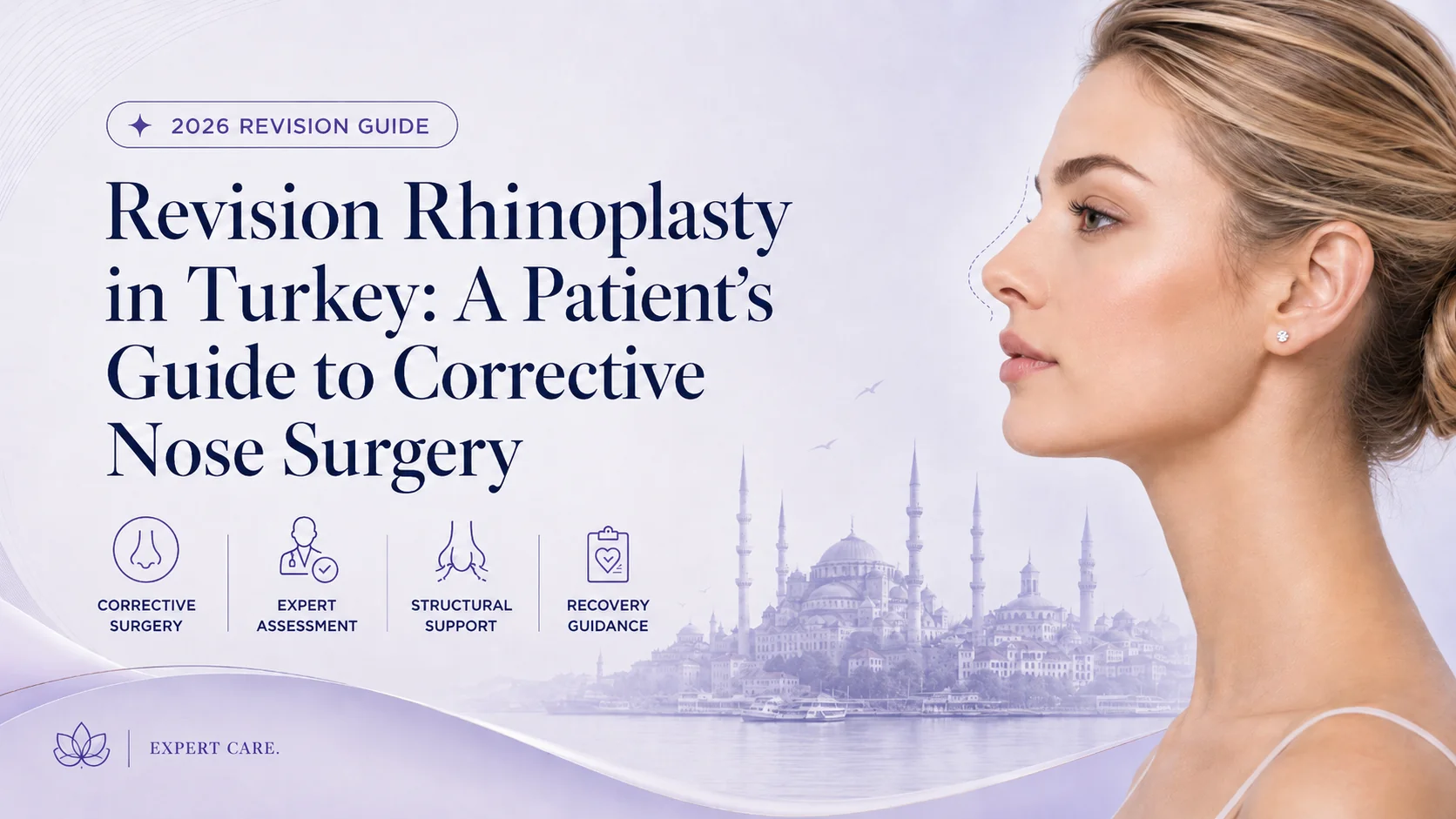

Revision Rhinoplasty in Turkey: A Patient’s Guide to Corrective Nose Surgery

Revision rhinoplasty in Turkey is corrective nose surgery for people who are unhappy with the result of a previous rhinoplasty, or who have developed breathing or structural problems since. It is a distinct, more demanding procedure than a first-time nose job, because the surgeon works with altered anatomy, scar tissue and sometimes a limited supply of cartilage. This guide explains what revision rhinoplasty involves, why it is more complex, how surgeons plan and perform it, what recovery is realistically like, and what to look for when choosing a surgeon and travelling to Turkey for corrective surgery.
Revision Rhinoplasty in Turkey: A Patient’s Guide to Corrective Nose Surgery

Table of Contents

Dr. Placeholder Name
Medically Reviewed
Reviewed by Op. Dr. Ömer Aşkıner — Board-Certified Plastic Surgeon

Get a Free 3D Rhinoplasty Simulation

Talk to an experienced patient coordinator about your rhinoplasty in Turkey.
Please enter a valid phone number.

Revision rhinoplasty in Turkey is corrective nose surgery for people who are unhappy with the result of a previous rhinoplasty, or who have developed breathing or structural problems since. It is a distinct, more demanding procedure than a first-time nose job, because the surgeon works with altered anatomy, scar tissue and sometimes a limited supply of cartilage. This guide explains what revision rhinoplasty involves, why it is more complex, how surgeons plan and perform it, what recovery is realistically like, and what to look for when choosing a surgeon and travelling to Turkey for corrective surgery.

Key Takeaways

  • Revision rhinoplasty is a second (or later) operation to correct aesthetic or functional concerns that persist or develop after a previous nose surgery.

  • It is generally more complex than a first-time (primary) rhinoplasty because the surgeon must work with altered anatomy, scar tissue, and sometimes a reduced supply of cartilage.

  • Most surgeons advise waiting until the nose has fully healed — often around 12 months after the previous operation — before planning a revision, because the nose keeps changing during this time.

  • Cartilage grafts are frequently needed to rebuild structure and support. Sources may be the septum, the ear, or the rib, and the choice depends on the individual case.

  • If you are considering surgery in Turkey, plan carefully for a thorough assessment, clear communication about realistic goals, and follow-up after you return home.

  • No surgeon can guarantee a perfect result, guaranteed breathing improvement, or a fixed recovery time. A responsible surgeon will explain what can and cannot realistically be achieved in your specific case.

What Is Revision Rhinoplasty?

Revision rhinoplasty, also called secondary rhinoplasty, is a surgical procedure performed to correct problems that persist or develop after a previous rhinoplasty. These problems may be minor and straightforward, or they may be more complex and require rebuilding of the nasal structure. The aim is to improve the appearance of the nose, its function (such as breathing), or both.

A revision may be needed after one previous operation, or after several. The right approach depends entirely on what happened during the earlier surgery and how the nose has healed.

Why Might Someone Need Revision Rhinoplasty?

People consider revision rhinoplasty for several reasons. It is important to understand that an unwanted result does not automatically mean the first surgeon made a mistake. Healing, individual anatomy, skin thickness, injury, and unrealistic initial expectations can all influence the final outcome.

Aesthetic concerns. The shape of the nose after the first surgery may not suit the face, or a specific feature may bother the patient — for example, a residual bump on the bridge, a drooping or over-rotated tip, asymmetry, or a nose that looks “over-operated.”

Breathing or functional problems. Some patients develop or continue to experience nasal obstruction after a primary rhinoplasty. This can be due to a septum that was not fully corrected, nasal valve collapse, or scar tissue narrowing the airway.

Structural problems. If too much cartilage or bone was removed during the first operation, the nose can lose support. This may lead to visible collapse, irregularities, or a weakened framework.

Changes during healing. The nose continues to change for many months after surgery. Sometimes concerns that appear early settle on their own; other times, changes such as scar contracture become more noticeable over time.

Revision rhinoplasty is not rare. Published estimates suggest that a meaningful minority of patients seek some form of revision after a first operation, with secondary cases generally revised more often than primary ones — one reason revision-specific experience matters when choosing a surgeon.

hecklist of factors a surgeon assesses before revision rhinoplasty, including cartilage supply, scar tissue, breathing and skin quality.

Why Is Revision Rhinoplasty More Complex Than Primary Rhinoplasty?

Revision rhinoplasty is generally considered more challenging than a first-time procedure. In a first rhinoplasty, the tissue planes have not been operated on before, so they are easier to separate. In a revision, several factors add difficulty:

  • Altered anatomy. The nose has already been reshaped, so the surgeon works with structures that differ from an untouched nose.

  • Scar tissue. Surgery creates scar tissue as part of healing. This can obscure the anatomy and make dissection harder and less predictable.

  • Reduced cartilage availability. The septum is often used as a graft source in the first operation, so it may no longer be available. The surgeon may need to look elsewhere for cartilage.

  • Previous structural changes. Support that was removed or weakened during the first surgery may need to be rebuilt.

  • The need for reconstruction. Many revisions are reconstructive rather than a simple “touch-up,” re-establishing the framework of the nose.

  • Realistic limits. Compromised blood supply and thick or scarred skin can limit how much refinement is possible.

Comparison graphic showing planning differences between primary and revision rhinoplasty, including scar tissue and cartilage availability.

Who May Be Considered for Revision Rhinoplasty?

A suitable candidate is generally an adult in good general health, who has concerns after a previous rhinoplasty, whose nose has fully healed, and who has realistic expectations about what surgery can achieve. A careful assessment is essential — not everyone who is unhappy with a previous result is a good surgical candidate.

Because patients seeking revision are often disappointed, an experienced surgeon will also consider psychological readiness and expectations. An honest conversation about goals matters, because surgery alone will not resolve underlying body-image concerns.

How Long Should You Wait Before Revision Rhinoplasty?

Most surgeons recommend waiting until the nose has fully healed before planning a revision — often around 12 months after the previous operation, though this varies from person to person. The nose changes gradually as swelling resolves and scar tissue softens, and operating too soon can make the outcome less predictable.

During the waiting period, a concern that seems to need surgery early on may improve on its own. This is why close follow-up, rather than rushing back to the operating theatre, is often the best first step.

What Can Revision Rhinoplasty Correct?

Revision rhinoplasty can address a range of aesthetic and functional concerns, depending on the individual case. Common examples include refining a residual bump or an uneven bridge, adjusting a drooping or pinched tip, improving asymmetry, rebuilding lost support, and correcting breathing problems such as nasal valve collapse or a residual septal deviation.

It is important to be clear that not every concern can be fully corrected, and results depend on the anatomy the surgeon has to work with. A responsible surgeon will explain what is realistic for your nose specifically.

The Role of Scar Tissue in Revision Rhinoplasty

Scar tissue is one of the main reasons a second operation is harder than the first. After any surgery, the body lays down scar tissue as it heals. In the nose, this can blur the normal tissue planes, make dissection more difficult, and change how the nose looks and feels.

Scar tissue can also affect the airway and the final shape. This is one reason surgeons prefer to wait until scarring has softened and stabilised before operating again. Managing scar tissue carefully is a core part of revision surgery.

Cartilage Grafts in Revision Rhinoplasty

Cartilage grafting is one of the most important tools in revision rhinoplasty. When cartilage has been removed, weakened, or reshaped during the first surgery, grafts are often used to rebuild support, improve the airway, and refine the shape. Sources differ because each has different qualities, and the best choice depends on how much cartilage is needed and how strong it must be.

Septal cartilage

The septum (the wall inside the nose) is usually the first choice when it is still available. It is easy to access, flat, and straightforward to shape. However, in revision cases the septum has often already been used or partly removed during the first operation, so there may not be enough left.

Ear (auricular) cartilage

Ear cartilage can be harvested through a small incision, usually hidden behind the ear. It is versatile and useful for certain grafts, but it is curved and softer than septal or rib cartilage, so it is not ideal for every structural need.

Rib (costal) cartilage

Rib cartilage provides a larger volume of strong material and is often used when significant reconstruction is needed or when other sources are inadequate. It involves an additional harvest site. Not every revision requires rib cartilage — many cases are managed with septal or ear cartilage, and the decision should be made for your individual case.

Surgeons differ in their preferences. Many prefer the patient’s own cartilage over synthetic implants, and a common order of preference is septum first, then ear, then rib — but this order is not fixed and depends on what each case needs.

Diagram showing three cartilage sources for revision rhinoplasty — septum, ear and rib — with notes on their qualities.

How Is Revision Rhinoplasty Planned?

Planning a revision is more detailed than planning a first operation. A thorough assessment usually includes a detailed history of the previous surgery, an examination of both the outside and inside of the nose, an assessment of breathing, skin quality and remaining cartilage, and standardised photographs from several angles.

The surgeon then explains what appears to have caused the current concern, what can realistically be achieved, and how they plan to do it. Where possible, operative notes from the previous surgery can help the surgeon plan more accurately.

Revision Rhinoplasty Consultation for International Patients

Many patients considering Turkey begin with an online consultation, sending photographs and their medical history before travelling. A typical photo set includes a straight-on view, both profiles, a base (nostril) view, and three-quarter angles, taken in good light without filters or heavy make-up.

An online review is a useful starting point, but photographs alone are not enough for a full assessment. A revision requires an internal examination of the nose and airway, which cannot be done remotely. Any online plan should be confirmed by an in-person examination before surgery. Ask in advance who you will speak to, in what language, and how your questions will be answered.

Checklist graphic of questions and documents to prepare for a revision rhinoplasty consultation.

How Revision Rhinoplasty Is Performed

The specifics vary widely between cases. In general, the surgeon accesses the nasal framework, carefully manages scar tissue, and then repairs or rebuilds the structure — often using cartilage grafts — to improve shape, support, and the airway. Because of the extra complexity, revision procedures can take longer than the original operation. Surgery is usually performed under general anaesthetic, but the details should be confirmed with your surgeon.

Where bone needs reshaping, some surgeons use ultrasonic (piezo) instruments, which are designed to cut and refine bone precisely while largely sparing the surrounding soft tissue. This can be useful in revision cases, where tissue is already scarred and precision matters, though it is one tool within the wider plan rather than a separate type of operation. Whether it is used depends on the individual case. The open or closed access decision is separate again from the tools used — see open vs closed rhinoplasty for how the two approaches compare.

Open or Closed Approach in Revision Rhinoplasty?

There is no single “best” approach for every revision. In an open approach, a small incision is made across the columella (the strip of tissue between the nostrils), giving the surgeon direct visibility of the nasal structures. In a closed approach, all incisions are inside the nostrils.

Many surgeons favour the open approach for complex or reconstructive revisions because it provides better access for precise graft placement and structural work. However, some revisions with milder concerns can be managed with a closed approach. The right choice depends on the individual case and the surgeon’s judgement and experience. For a detailed explanation of the closed technique, see closed rhinoplasty in Turkey.

Revision Rhinoplasty Recovery

Recovery after revision rhinoplasty follows the same broad stages as primary surgery, but it often takes longer because the tissues have already been operated on and scar tissue is involved. The timeline below is a general guide; your own recovery depends on how much reconstruction was done, your skin type and how you heal, and it cannot be guaranteed.

First week

A splint supports the nose and is usually removed at around one week. Swelling and bruising around the nose and eyes are common and tend to be most noticeable in the first few days. Rest with the head elevated is typically advised, and the nose will feel blocked.

Weeks 2–4

Most obvious bruising settles during this period, and many people feel comfortable in social settings within a few weeks. Because revision involves scarred tissue, early swelling can be a little more stubborn than after a first operation.

Months 2–6

Swelling continues to settle gradually. The nose starts to show its new shape, but it is still refining, and the tip in particular holds swelling longer — especially in patients with thicker skin. Interim results at this stage should not be judged as final.

Months 6–12 and beyond

The final shape can take a year or longer to appear after a revision, sometimes longer than a primary rhinoplasty because scar tissue takes time to soften and settle. Your surgeon should give you clear aftercare instructions and a follow-up plan, and remote follow-up matters if you have travelled home.

Recovery timeline for revision rhinoplasty showing swelling and healing stages from the first week through twelve months and beyond.

Risks and Limitations of Revision Rhinoplasty

All surgery carries risk, and revision rhinoplasty carries the general risks of nasal surgery — including bleeding, infection, poor wound healing, prolonged swelling, and asymmetry. Because revision involves altered tissue and sometimes compromised blood supply, some risks can be higher than in a primary operation, and there is a possibility that a further revision may be wanted or needed.

There are also real limitations. Thick or scarred skin can limit how much refinement is visible, and the amount of usable cartilage may restrict what is possible. A surgeon should discuss these risks and limits honestly before you decide.

What Results Can Patients Realistically Expect?

Revision rhinoplasty can achieve meaningful improvements in appearance and function for many patients, but it cannot guarantee a perfect nose, perfect symmetry, or guaranteed breathing improvement. The result depends on your anatomy, your skin, the previous surgery, and how you heal.

A trustworthy surgeon focuses on realistic, natural-looking improvement rather than perfection, and is honest when a goal cannot safely be achieved. Setting realistic expectations is one of the most important parts of a successful revision journey.

Choosing a Revision Rhinoplasty Surgeon in Turkey

Choosing a surgeon is one of the most important decisions in a revision journey, and it is worth taking time over. Because revision is complex, look for practical evidence that a surgeon regularly handles these cases.

Consider the following:

  • Experience with revision cases. Ask specifically how often they perform revision (not just primary) rhinoplasty and how comfortable they are operating on a previously altered nose.

  • Functional assessment. A good surgeon assesses breathing and the airway, not only appearance.

  • Discussion of grafting. They should be able to explain whether grafts may be needed and where cartilage might come from in your case.

  • Realistic communication. They should clearly explain what can and cannot be achieved, rather than promising a guaranteed result.

  • Previous-case documentation. Ask to see before-and-after examples of revision cases similar to yours.

  • Facility context. Understand where the surgery will take place and the standard of the facility.

  • Aftercare and follow-up. Ask how follow-up is handled, especially once you return home.

  • International communication. Confirm how you will communicate before and after surgery, and in what language.

Be cautious of anyone who guarantees results, downplays the complexity of revision, or focuses on price above assessment.

Questions to Ask Before Revision Rhinoplasty

Use this practical checklist during your consultation:

  • How many revision rhinoplasty procedures do you perform, and how often?

  • What do you think caused the concern I have now?

  • What can realistically be improved in my case, and what cannot?

  • Will I need cartilage grafts, and if so, from where?

  • Do you recommend an open or closed approach for me, and why?

  • What are the main risks and limitations for my nose specifically?

  • How long should I expect recovery and final results to take?

  • Will I have an in-person examination before surgery?

  • How is follow-up handled after I return home?

  • What happens, and what are the costs, if a further revision is needed?

Travelling to Turkey for Revision Rhinoplasty

If you travel to Turkey for a revision, a few points are especially relevant to corrective surgery. Because revision is complex and healing can take longer, plan enough time in the country for your surgeon to see you after the operation before you fly home. Air travel too soon after surgery is generally discouraged, so confirm the recommended waiting time before flying.

Aftercare continuity is a particular consideration for international patients, because follow-up is harder to arrange once you are back home. Before booking, confirm exactly how follow-up will work once you are home, what is included in writing, and what happens if a complication or further revision is needed. Verify the surgeon’s credentials and the facility’s standards rather than relying on marketing. For the general patient journey, transfers, and accommodation, see our main guide, rhinoplasty in Turkey.

How Much Does Revision Rhinoplasty Cost in Turkey?

The cost of revision rhinoplasty in Turkey depends heavily on the individual case — including the complexity of the previous surgery, how much reconstruction is required, and whether cartilage grafts are needed. Because a revision can range from a minor adjustment to a major structural rebuild, there is no single price, and a meaningful figure can only be given after assessment.

For a detailed breakdown, see our dedicated page, revision rhinoplasty cost in Turkey. For general (primary) nose surgery pricing, see rhinoplasty cost in Turkey.

Revision vs Primary Rhinoplasty

Feature

Primary Rhinoplasty

Revision Rhinoplasty

Tissue condition

Untouched tissue planes

Altered anatomy and scar tissue

Complexity

Generally less complex

Generally more complex

Cartilage availability

Septum usually available

Septum may be depleted; ear or rib may be used

Main aim

Reshape and/or improve function

Correct or rebuild after a previous operation

Reconstruction

Sometimes

Often required

Healing

Nose settles over ~1 year

Can take a year or longer

Planning

Standard assessment

More detailed; history and internal exam important

Frequently Asked Questions

Is revision rhinoplasty harder than the first operation?
Yes, in most cases. Revision rhinoplasty is generally more complex because the surgeon works with altered anatomy, scar tissue, and sometimes a reduced supply of cartilage. Many revisions involve rebuilding structure rather than a simple adjustment, which is why revision-specific experience matters.
How long should I wait before a revision?
Most surgeons recommend waiting until the nose has fully healed — often around 12 months after the previous surgery — though this varies. The nose keeps changing as swelling settles and scar tissue softens, and operating too early can make the result less predictable.
Can revision rhinoplasty fix breathing problems?
It often can address breathing problems caused by issues such as nasal valve collapse or a residual septal deviation, frequently using cartilage grafts to restore support. However, no surgeon can guarantee improved breathing, and the outcome depends on the individual case.
Will I definitely need rib cartilage?
No. Not every revision needs rib cartilage. The septum is usually the first choice when available, ear cartilage is used in many cases, and rib cartilage is generally reserved for larger reconstructions or when other sources are inadequate. The choice is made for your case.
Is an online consultation enough before travelling to Turkey?
An online consultation with photos is a useful starting point, but it is not a substitute for an in-person examination. A revision needs an internal assessment of the nose and airway, so any remote plan should be confirmed by a physical examination before surgery.
Does an unwanted result mean my first surgeon made a mistake?
Not necessarily. Healing, individual anatomy, skin thickness, injury, and expectations can all affect the outcome. An unwanted result does not automatically mean the previous surgeon did something wrong.
How long does recovery take?
Initial recovery is usually around one to two weeks, but the final shape can take a year or longer to appear, especially with thicker skin. Recovery timelines vary between individuals and cannot be guaranteed.

Medical Disclaimer

This article is for general information only and does not constitute medical advice. It does not replace a consultation with a qualified surgeon. Outcomes, risks, and recovery vary between individuals, and no result can be guaranteed. Always seek personalised advice from an appropriately qualified and registered medical professional before making any decision about surgery.

Contact Us!

Please enter a valid phone number.