
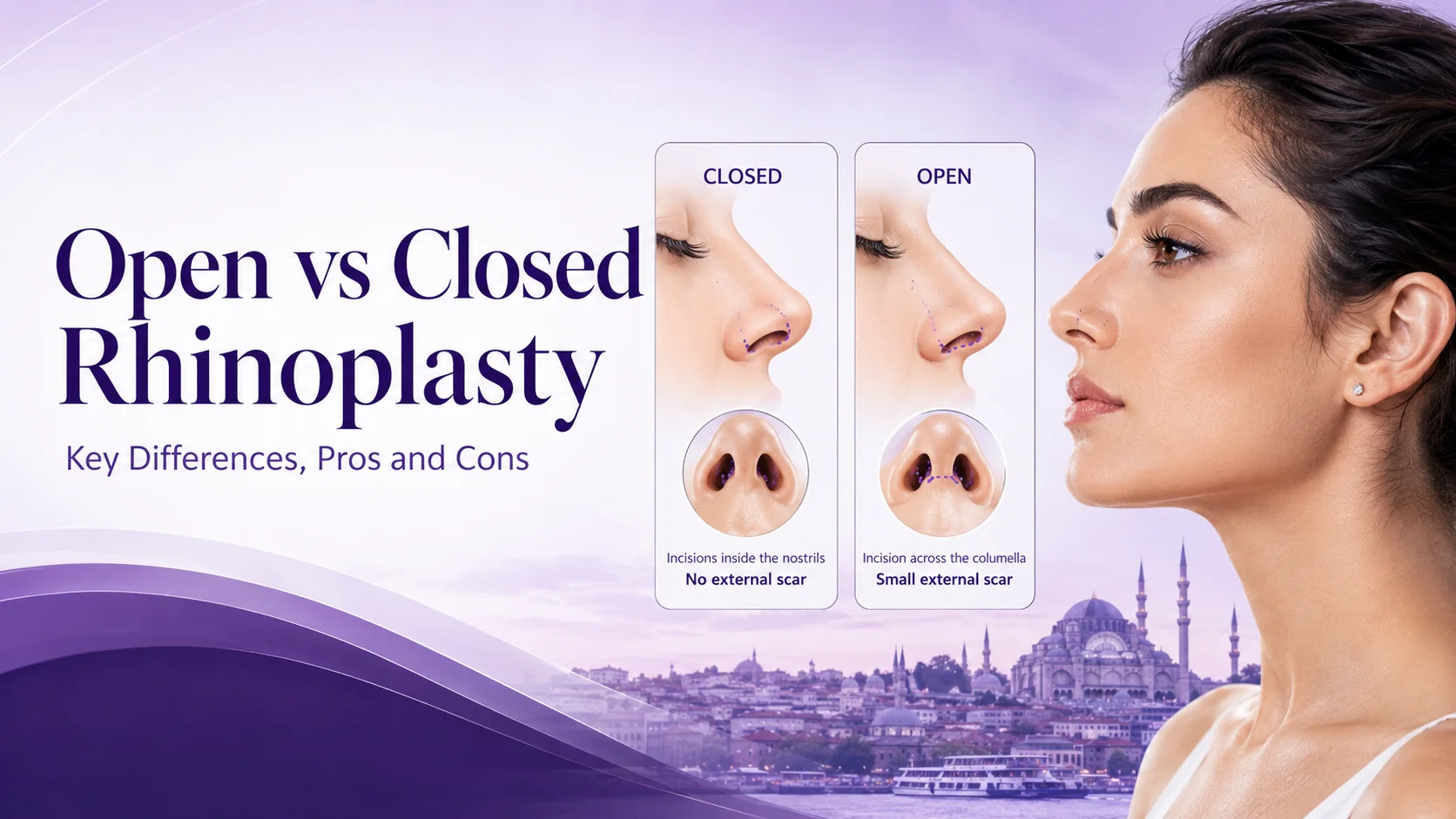

Open vs Closed Rhinoplasty: Key Differences, Pros and Cons

Open and closed rhinoplasty are the two main ways a surgeon can access the nose to reshape it. Patients often meet these terms while researching a nose job and assume one is simply “better” — but the reality is more nuanced. This guide compares the two approaches directly: where the incisions go, how surgical exposure, scarring, swelling and recovery differ, and how a surgeon actually decides between them. It also untangles a few common myths, such as “closed is scarless” and “closed always heals faster”.
Open vs Closed Rhinoplasty: Key Differences, Pros and Cons

Table of Contents

Dr. Placeholder Name
Medically Reviewed
Reviewed by Op. Dr. Ömer Aşkıner — Board-Certified Plastic Surgeon

Get a Free 3D Rhinoplasty Simulation

Talk to an experienced patient coordinator about your rhinoplasty in Turkey.
Please enter a valid phone number.

Key Takeaways

  • The core difference is access: open rhinoplasty adds a small incision across the columella; closed rhinoplasty keeps every incision inside the nostrils.

  • Open generally gives broader direct exposure of the nasal framework, which can help with complex structural work.

  • Closed avoids an external columellar scar — but it is not literally “scarless”, because incisions still heal inside the nose.

  • Recovery is driven mostly by what is done, not how it is accessed; some patients may have more persistent tip swelling after an open approach, but the evidence does not show a consistent overall swelling advantage for either technique.

  • Grafts can be placed through either approach, and closed rhinoplasty is not limited to minor changes.

  • Neither approach is universally better — suitability depends on anatomy, the planned correction and the surgeon’s assessment.

  • Revision does not automatically mean open; a large share of revision cases are performed closed, depending on the case.

What Is the Difference Between Open and Closed Rhinoplasty?

Open and closed rhinoplasty differ mainly in how the surgeon reaches the nasal framework. Open rhinoplasty uses incisions inside the nostrils plus a small incision across the columella (the strip of skin between the nostrils), so the skin can be lifted for wider direct exposure. Closed rhinoplasty places all incisions inside the nostrils and avoids the columellar incision. The most suitable approach depends on the correction needed, the anatomy and the surgeon’s assessment — not on which technique sounds better.

Open vs Closed Rhinoplasty at a Glance

Feature

Open Rhinoplasty

Closed Rhinoplasty

Incisions

Inside the nostrils + across the columella

Inside the nostrils only

External columellar incision

Yes (small)

No

Surgical exposure

Broader direct exposure

More limited, technique-dependent access

External scar

Small columellar scar, usually fades

No external columellar scar

Early swelling

Case-dependent; may vary with extent of surgery

Case-dependent; no guaranteed recovery advantage

Structural work / grafting

Facilitates complex work

Possible, but complex work can be harder

Suitability

Depends on anatomy and planned work

Depends on anatomy and planned work

Result quality

Not determined by approach alone

Not determined by approach alone

Comparison of open and closed rhinoplasty showing incision placement, surgical exposure and external scar differences.

How Does Open Rhinoplasty Work Compared With Closed Rhinoplasty?

Both approaches reshape the same bone and cartilage; they differ in how the surgeon reaches it — and that access difference also affects exposure and how easily certain manoeuvres can be performed. The comparison below keeps each approach brief and side-by-side; for the full procedure, follow the internal links.

The Open Approach

Open rhinoplasty joins internal incisions to a small incision across the columella, then lifts the nasal skin to expose the framework directly. This gives the surgeon a clear, undistorted view, which can help with detailed or structural work. For the full procedure, see open rhinoplasty in Turkey.

The Closed Approach

Closed rhinoplasty works entirely through incisions inside the nostrils, without lifting the skin as fully, so there is no external columellar incision. The surgeon relies more on tactile feedback and experience. For the full procedure, see closed rhinoplasty in Turkey.

How Open and Closed Rhinoplasty Differ in Complex Surgery

Surgical Exposure

Open rhinoplasty generally offers broader direct exposure of the nasal structures, while closed rhinoplasty works through more limited access. Seeing the framework directly can make certain manoeuvres easier — placing grafts, correcting asymmetry or performing detailed tip work. But more exposure does not automatically mean a better result. Final precision also depends on surgical planning, technique, experience and the anatomy itself, so a skilled surgeon can achieve excellent results through either approach in a suitable case.

Tip Work

For complex nasal tip work, the open approach is often preferred because it lets the surgeon see and adjust the tip cartilages directly. This can help with three-dimensional sculpting, correcting a bulbous or asymmetric tip, or rebuilding support. Closed rhinoplasty can still refine the tip — sometimes using a delivery technique that exposes the tip cartilages through internal incisions — but very detailed tip reshaping can be more demanding this way. The right choice depends on how much tip work is planned.

Structural Changes and Grafting

Cartilage grafts can be placed through either approach, but extensive structural work and grafting are often easier through the open approach because of the clearer view. It is a myth that closed rhinoplasty cannot involve grafts — support grafts and sutures are regularly placed endonasally. What differs is the ease of very complex, precise graft positioning. Where a nose needs major rebuilding, a surgeon may lean towards open access; where changes are more contained, closed access may handle grafting well.

Where Does Ultrasonic (Piezo) Rhinoplasty Fit In?

Ultrasonic (piezo) rhinoplasty is not a third alternative to open and closed — it is a tool used within either approach. “Open” and “closed” describe how the surgeon accesses the nose; “ultrasonic” describes the instrument used to reshape the bone. Piezoelectric instruments are designed for precise bone cutting and have been associated with reduced soft-tissue trauma compared with conventional osteotomy techniques, and they can be used in an open or a closed operation.

This matters because patients often search “open vs closed vs ultrasonic” as if choosing between three options. In practice, a surgeon might perform an ultrasonic closed rhinoplasty or an ultrasonic open rhinoplasty. Piezo instruments are also central to many preservation techniques, which aim to reshape the bridge by repositioning the natural bone rather than removing and rebuilding it. Piezo can be used with either approach, although specialised instruments and access techniques may be required when working endonasally.

So the access decision (open or closed) and the bone-shaping tool (conventional or ultrasonic) are separate choices. For how piezo and preservation techniques are used through internal incisions, see closed rhinoplasty in Turkey.

Open vs Closed Rhinoplasty Scars

Open rhinoplasty leaves a small scar on the columella that usually fades and becomes hard to notice, while closed rhinoplasty leaves no external columellar scar at all — but neither is truly “scarless”. Both approaches create internal incisions inside the nose that heal like any wound; the difference is only whether there is also a small external incision.

Two points are worth clearing up, because they are among the most over-marketed in rhinoplasty:

  • “Closed rhinoplasty is scarless” is misleading. There is no external columellar scar, but internal incisions still form scar tissue inside the nose.

  • The open scar is usually minor. The small columellar scar typically matures and fades for most patients. Scar visibility varies between individuals and can be influenced by incision design, closure technique, wound healing and aftercare.

Medical illustration comparing incision locations in open and closed rhinoplasty.

Open vs Closed Rhinoplasty Recovery

Recovery timelines are broadly similar for both approaches, because recovery is driven by what was done rather than how the nose was accessed. Many sources claim closed rhinoplasty is dramatically faster, but the honest picture is more modest.

General Timeline

For both approaches, the splint usually comes off at about a week, bruising settles by two to three weeks, desk work is often possible within one to two weeks, and the final shape can take up to a year (and sometimes longer) to fully settle. The staged pattern — early swelling and bruising, then a longer period of subtle refinement with the tip settling last — is similar whichever approach is used.

Swelling and Bruising

Some patients may experience more persistent tip swelling after an open approach, because lifting the skin flap can briefly affect lymphatic drainage at the tip. However, comparative evidence does not show a consistent overall swelling advantage for either approach. The extent of surgery, tissue handling, whether bone work is involved and individual healing all matter — a closed rhinoplasty with bone work can bruise more than a gentle open tip refinement.

For full, approach-specific recovery detail, see open rhinoplasty in Turkey and closed rhinoplasty in Turkey.

Open vs Closed Rhinoplasty: Advantages and Limitations

Each approach has genuine trade-offs, and the “best” one is simply the one that fits the surgical task. The table below summarises the balanced picture.

Approach

Potential advantages

Potential limitations

Open rhinoplasty

Broad direct exposure; helpful for complex structural work, detailed tip sculpting and precise grafting

Small columellar incision and scar; may involve more persistent tip swelling in some patients

Closed rhinoplasty

No external columellar incision; potentially less soft-tissue disruption in suitable cases

More limited exposure; very complex work or extensive grafting can be more technically demanding

Which Is Better: Open or Closed Rhinoplasty?

Neither open nor closed rhinoplasty is universally better. The more appropriate approach depends on your nasal anatomy, the changes required, any previous surgery, whether grafting is needed, functional concerns, and the surgeon’s experience and treatment plan. A surgeon who is skilled in both approaches chooses the one that best fits the operation, not the one that markets well. This is why two good surgeons can reasonably recommend different approaches for the same nose — and why the surgeon’s judgement matters more than the label.

This is consistent with the comparative evidence. Available studies have not established a consistent overall advantage for either approach in patient-reported outcomes, complications or revision rates. Approach selection should therefore be based on the individual case and the surgeon’s expertise with the techniques being considered, rather than on a belief that one access route is generally superior.

Factors surgeons consider when choosing between open and closed rhinoplasty.

Who May Be Better Suited to Open or Closed Rhinoplasty?

Broadly, more extensive structural work tends to favour open access, while more contained corrections may be handled through a closed approach — but these are general tendencies, not candidacy rules. Only an in-person assessment can decide what suits your nose.

May favour open access

May favour closed access

More extensive structural work

More contained corrections

Complex tip work

Selected bridge work (e.g. smoothing a hump)

Extensive grafting or reconstruction

Selected tip refinement

Significant asymmetry

Modern endonasal techniques for substantial but contained change

Some revision cases

Some primary and selected revision cases

These are general tendencies, not candidacy rules. Detailed candidacy is covered on the dedicated open and closed rhinoplasty pages.

Open vs Closed Rhinoplasty for Revision Surgery

Revision surgery does not automatically require an open approach, although broader exposure is often useful in complex revision cases. Previous surgery can alter anatomy, create scar tissue and reduce available cartilage, which may make direct access and structural grafting helpful. But a substantial share of revision cases are still performed through a closed approach — so “revision always means open” is not accurate. The right choice depends on what the individual nose needs.

For a detailed explanation of previous surgery, scar tissue, grafting and secondary nasal surgery, see our guide to revision rhinoplasty in Turkey.

Does Open or Closed Rhinoplasty Produce More Natural Results?

The surgical approach alone does not determine whether a rhinoplasty result looks natural. Planning, anatomy, surgical execution, and how well nasal support is preserved or rebuilt matter far more than the name of the access technique. A natural result comes from realistic goals and skilled surgery, and can be achieved through either approach in the right hands.

Can Both Open and Closed Rhinoplasty Improve Breathing?

Both open and closed approaches can be used as part of a rhinoplasty that also addresses functional concerns, such as a deviated septum or nasal-valve problems. The access approach itself does not determine whether breathing will improve; that depends on the underlying problem and the functional work included in the surgical plan. Comparative studies have not shown a consistent difference between open and closed approaches in breathing-related outcomes, so functional correction is planned around the specific issue rather than the access route. Where reshaping and breathing correction are combined, the procedure may be planned as a septorhinoplasty.

Is Open or Closed Rhinoplasty Safer?

Neither approach is inherently safer; overall safety depends on the patient, the complexity of the surgery and the standard of care rather than the access technique. Factors such as your health, the surgeon’s judgement, anaesthesia, the facility and postoperative care matter more than whether the nose is accessed open or closed. Both are established, widely used techniques, and comparative studies have not shown a consistent overall difference in complication rates between them.

Does Open or Closed Rhinoplasty Cost More?

The surgical approach alone does not reliably determine the price of rhinoplasty. Complexity, operating time, the surgeon, the hospital, any functional work and grafting can all influence a quotation more than whether the technique is open or closed. It is not accurate to assume open is automatically more expensive or closed automatically cheaper.

For general price ranges and what a package includes, see rhinoplasty cost in Turkey. If your case involves previous surgery, revision-specific pricing is covered under revision rhinoplasty cost in Turkey.

How Does a Surgeon Decide Between Open and Closed Rhinoplasty?

A surgeon chooses the approach by matching the access to the surgical task, weighing your anatomy and goals against what each technique makes easier.

Key factors include:

  • Nasal anatomy, skin thickness and soft-tissue characteristics

  • Tip anatomy and how much tip work is needed

  • Septal anatomy and structural support

  • Whether grafting or reconstruction is required

  • Functional (breathing) requirements

  • Any previous surgery and scar tissue

  • Overall complexity of the planned correction

  • The surgeon’s own experience and technique

Skin thickness can affect surgical planning, swelling and how structural changes become visible, but it should not be used as a standalone rule for choosing an open or closed approach. As with every factor here, it is weighed individually rather than applied as a fixed rule.

Questions to Ask During Your Consultation

When comparing surgeons, ask why a specific approach is recommended for your anatomy rather than choosing a clinic simply because it advertises one technique. A good surgeon will explain their reasoning clearly.

Useful questions include:

  • Why are you recommending this approach for my anatomy?

  • What correction requires this type of access?

  • Where exactly will the incisions be, and will I have a columellar incision?

  • What tip or structural work is planned, and is grafting expected?

  • Could the approach change after an in-person examination?

  • How much experience do you have with the recommended approach?

  • How does the expected recovery relate to the extent of my procedure?

  • What are the main risks in my individual case?

For the full treatment and travel journey, see rhinoplasty in Turkey.

Key differences between open and closed rhinoplasty including incisions, surgical exposure, scars and recovery considerations.

Frequently Asked Questions

What is the main difference between open and closed rhinoplasty?
The main difference is access. Open rhinoplasty adds a small incision across the columella and lifts the skin for wider direct exposure of the nasal framework. Closed rhinoplasty keeps all incisions inside the nostrils and avoids the columellar incision. Both reshape the same bone and cartilage.
Which is better: open or closed rhinoplasty?
Neither is universally better. The right approach depends on your anatomy, the changes needed, any previous surgery, grafting requirements and the surgeon’s assessment. A surgeon skilled in both chooses the one that best fits the operation, which is why two surgeons may reasonably differ.
Does open rhinoplasty leave a visible scar?
It leaves a small scar on the columella. For most patients this matures and becomes hard to notice, though final appearance varies. Scar visibility can be influenced by incision design, closure technique, wound healing and aftercare. It is usually a minor trade-off for the added exposure.
Is closed rhinoplasty completely scarless?
No. Closed rhinoplasty leaves no external columellar scar, but it is not truly scarless — the incisions inside the nostrils still heal and form scar tissue internally, where it is not visible from the outside. “Scarless” is marketing shorthand, not a literal description.
Does closed rhinoplasty heal faster than open rhinoplasty?
Not dramatically. Recovery is driven mainly by what was done, not how the nose was accessed. Timelines are broadly similar, and comparative evidence does not show a consistent overall recovery advantage for either approach — though some patients may have more persistent tip swelling after an open approach.
Does open rhinoplasty cause more swelling?
Some patients may have more persistent tip swelling after an open approach, because lifting the skin flap can briefly affect lymphatic drainage. But overall swelling depends more on the extent of surgery than the access route — a closed rhinoplasty with bone work can bruise more than a gentle open tip refinement.
Is open rhinoplasty better for complex nose surgery?
Open access is commonly favoured when complex structural work requires broader direct exposure, but complexity alone does not automatically make it the better approach for every patient. Skilled surgeons achieve excellent results with either approach in suitable cases.
Is open rhinoplasty always required for revision surgery?
No. Revision often benefits from broader exposure because previous surgery can alter anatomy and reduce cartilage, but not every revision needs the open approach — a substantial share are performed closed. The right choice depends on the individual case.
Can cartilage grafts be used in closed rhinoplasty?
Yes. Grafts and support sutures can be placed through the closed approach, sometimes using a delivery technique. Very complex or extensive grafting can be easier through open access, but “closed” does not mean “no grafts”.
Is ultrasonic (piezo) rhinoplasty different from open and closed?
It’s a different kind of choice. “Open” and “closed” describe how the nose is accessed; “ultrasonic” (piezo) describes the tool used to reshape the bone. Piezo can be used within either an open or a closed operation, so it is not a third alternative.

Medical Sources & Review

This comparison draws on peer-reviewed literature and clinical evidence. Key sources include:

  1. Systematic review / meta-analysis of open vs closed rhinoplasty outcomes (2025) — reported no consistent overall difference in patient-reported outcomes (e.g. ROE), breathing scores (NOSE), oedema, bruising, operative time, satisfaction or complication rates.
  2. Earlier systematic reviews comparing open and closed approaches, showing case-dependent rather than universal differences.
  3. Large rhinoplasty case-series / registry data (European facial-plastic-surgery datasets), including secondary (revision) rhinoplasty performed via both open and closed access.
  4. Systematic reviews of piezoelectric (ultrasonic) osteotomy, associated with reduced soft-tissue trauma versus conventional osteotomy.
  5. Columellar-incision scar literature (e.g. Kilavuz et al., Facial Plastic Surgery, 2017), referenced on the open rhinoplasty page.

Medical Disclaimer

This article provides general educational information comparing open and closed rhinoplasty. Open and closed rhinoplasty are surgical approaches rather than universally interchangeable options, and suitability depends on individual anatomy and treatment requirements. Risks, recovery, scarring and results vary between patients. The surgical approach should be determined through consultation with an appropriately qualified medical professional, and this information does not replace individual medical assessment.

Contact Us!

Please enter a valid phone number.