
Before the Procedure
Preparation for open rhinoplasty centres on a thorough assessment and following your surgeon’s and anaesthesia team’s instructions. A typical work-up includes a review of your medical history, an examination of the nose inside and out, standardised photographs, and an anaesthesia assessment before the surgery date is confirmed. Your surgeon will also discuss your goals and what is realistically achievable.
You will usually be given individual guidance on medicines and supplements — some, such as blood thinners and certain herbal supplements, may need pausing, but only on your surgeon’s advice, and you should never stop prescribed medication without checking. If you smoke, stopping well beforehand supports healing, as nicotine restricts blood flow to the recovering tissue. Always follow the specific pre-operative instructions your clinic gives you rather than general advice.
How Does Open Rhinoplasty Work?
Open rhinoplasty works by lifting the nasal skin to expose the framework, reshaping the bone and cartilage under direct vision, and then re-draping the skin and closing the incisions. The procedure is normally performed under general anaesthesia and, depending on complexity, commonly takes in the region of two to three hours. The main stages are outlined below at an educational level.
The Transcolumellar Incision
The surgeon makes a small incision across the columella, the strip of skin between the nostrils, and joins it to incisions inside each nostril. This external incision is usually only a few millimetres long, and an inverted-V or stepped shape may be used depending on surgeon preference and the individual nose.
Accessing the Nasal Framework
Once the incisions are made, the nasal skin — the soft-tissue envelope — is gently lifted upward off the framework. This exposes the cartilage and bone so the surgeon can see the structures directly, in their natural position and without distortion. Working under this clear view is the defining feature of the open approach, and it is what allows fine, millimetre-level adjustments.
Reshaping Bone and Cartilage
With the framework exposed, the surgeon can reshape the bridge, refine the tip, correct deviations and place cartilage grafts where the plan requires. Where the bone needs adjusting, controlled techniques such as osteotomies may be used. The work carried out depends entirely on the individual treatment plan.
Where the bone is reshaped, some surgeons use ultrasonic (piezo) instruments, which are designed to cut and refine bone precisely while largely sparing the surrounding soft tissue. Piezo is a tool that can be used within the open approach rather than a different type of operation, and whether it is used depends on the individual plan. The access decision (open or closed) and the bone-shaping tool (conventional or ultrasonic) are separate choices — see open vs closed rhinoplasty for how the two approaches compare.
Closing the Incision and Supporting the Nose
After reshaping is complete, the nasal skin is repositioned over the new framework and the incisions are closed with fine sutures. The columellar incision may be closed with either absorbable or non-absorbable sutures; where non-absorbable sutures are used, they are typically removed at around one week. An external splint is usually applied to the bridge to support and protect the new shape while it begins to heal, and soft internal supports or dressings are sometimes placed inside the nostrils for a short period. The splint generally stays on for about the first week and is removed at the first follow-up.

Why Might a Surgeon Recommend Open Rhinoplasty?
A surgeon may recommend open rhinoplasty when the treatment plan calls for detailed structural work that benefits from direct visual access. The open approach is often associated with cases where precision and control over the framework matter most. It is a clinical judgement made after assessment, not an automatic default.
Situations where an open approach may be considered include:
Complex nasal tip work, where fine adjustments to shape, support and symmetry are needed.
Structural correction or reconstruction, when the framework needs rebuilding rather than simple refinement.
Noticeable asymmetry, where seeing both sides directly can help.
Cartilage grafting, where grafts must be positioned accurately.
Some revision cases, where anatomy has been altered by previous surgery.
This does not mean every complex nose requires an open approach, or that revision always uses it. Where previous surgery is the main issue, see revision rhinoplasty in Turkey for detail on how those cases are planned.
Who May Be Suitable for the Open Approach?
Suitability for open rhinoplasty depends on individual assessment rather than a fixed list of candidates. In general, the approach is often discussed for patients who need detailed structural or tip work, significant reshaping, correction of asymmetry, or grafting. A surgeon weighs your anatomy, goals, skin type and any previous surgery before recommending an approach. Rhinoplasty is generally not performed until facial growth is complete, so age is one of the factors considered.
Open rhinoplasty can be used to address the shape of the nasal bridge and tip, projection and rotation, asymmetry, structural support and, in some cases, functional concerns. What can be achieved depends on the individual anatomy and goals discussed at assessment, so outcomes should never be assumed in advance. The table below shows the structures a surgeon typically evaluates.
Area |
What may be evaluated |
|---|---|
Nasal tip |
Shape, support and symmetry |
Bridge |
Bone and cartilage structure |
Septum |
Alignment and support |
Breathing |
Functional concerns, where relevant |
Skin / soft tissue |
Thickness and healing considerations |
Previous surgery |
Existing structural changes, if applicable |

Skin Type and Ethnic Rhinoplasty
Skin thickness is one of the factors a surgeon weighs. Patients with thicker skin — which is common in many ethnic rhinoplasty cases, such as African, Middle Eastern or some Asian noses — sometimes benefit from the stronger structural support and grafting that the open approach can provide, because thicker skin relies more on a well-defined framework underneath to show a refined shape. This is a general tendency rather than a rule: some thicker-skinned patients are well suited to a closed approach, and skin type is only one part of the assessment alongside tip anatomy, structural needs and goals. The aim in every case is a natural result that suits the individual face, not a standardised nose.
Advantages of Open Rhinoplasty
The main potential advantage of open rhinoplasty is direct visual access to the nasal framework, which can support precise structural work. These are potential benefits in the right case, not universal advantages for every patient.
Direct visualisation of the cartilage and bone in their natural position.
Access for complex structural work and reconstruction.
Accurate graft positioning, which can matter for support and shape.
Detailed tip work, where fine control is important.
Limitations and Considerations of Open Rhinoplasty
The main considerations with open rhinoplasty are the small external incision, a scar that varies by individual, and potentially more swelling and a slightly longer early recovery than the closed approach. Because the technique involves lifting the nasal skin, there can be more tissue handling, which some sources associate with more pronounced early swelling. None of this makes the open approach a “bigger” or “worse” operation — it reflects the trade-offs of direct access.
A small external (transcolumellar) incision and resulting scar
Potentially more early swelling and bruising than the closed approach
An initial recovery that may take slightly longer
Healing that varies from person to person
Greater surgical complexity in some cases
Does Open Rhinoplasty Leave a Scar?
Yes — open rhinoplasty leaves a small scar on the columella, at the base of the nose between the nostrils, but it is usually only a few millimetres long and often fades over several months. How the scar settles depends on the individual, wound care and how the incision heals. A well-placed and well-cared-for incision commonly becomes difficult to notice over time, but no surgeon can promise an invisible scar.
The external incision matures gradually. In the early weeks it may be firmer, slightly raised or pink, and more noticeable. Over the following months it typically softens, flattens and fades — a process called scar maturation that can continue for up to a year. Careful wound care and following your surgeon's aftercare guidance, including protecting the area from the sun during healing, can support a better result. If the incision heals poorly it can occasionally become raised or more visible, which is one reason surgical technique and aftercare matter.
What the incision is closed with appears to make little difference to the final scar: a Turkish study of columellar closure (Kilavuz et al., Facial Plastic Surgery, 2017) found no significant difference in scar scores between absorbable and non-absorbable sutures. The practical takeaway is that a small, well-placed columellar scar generally heals well regardless of the specific suture chosen, and that surgical care and aftercare matter more than the suture material itself.

Open Rhinoplasty Recovery
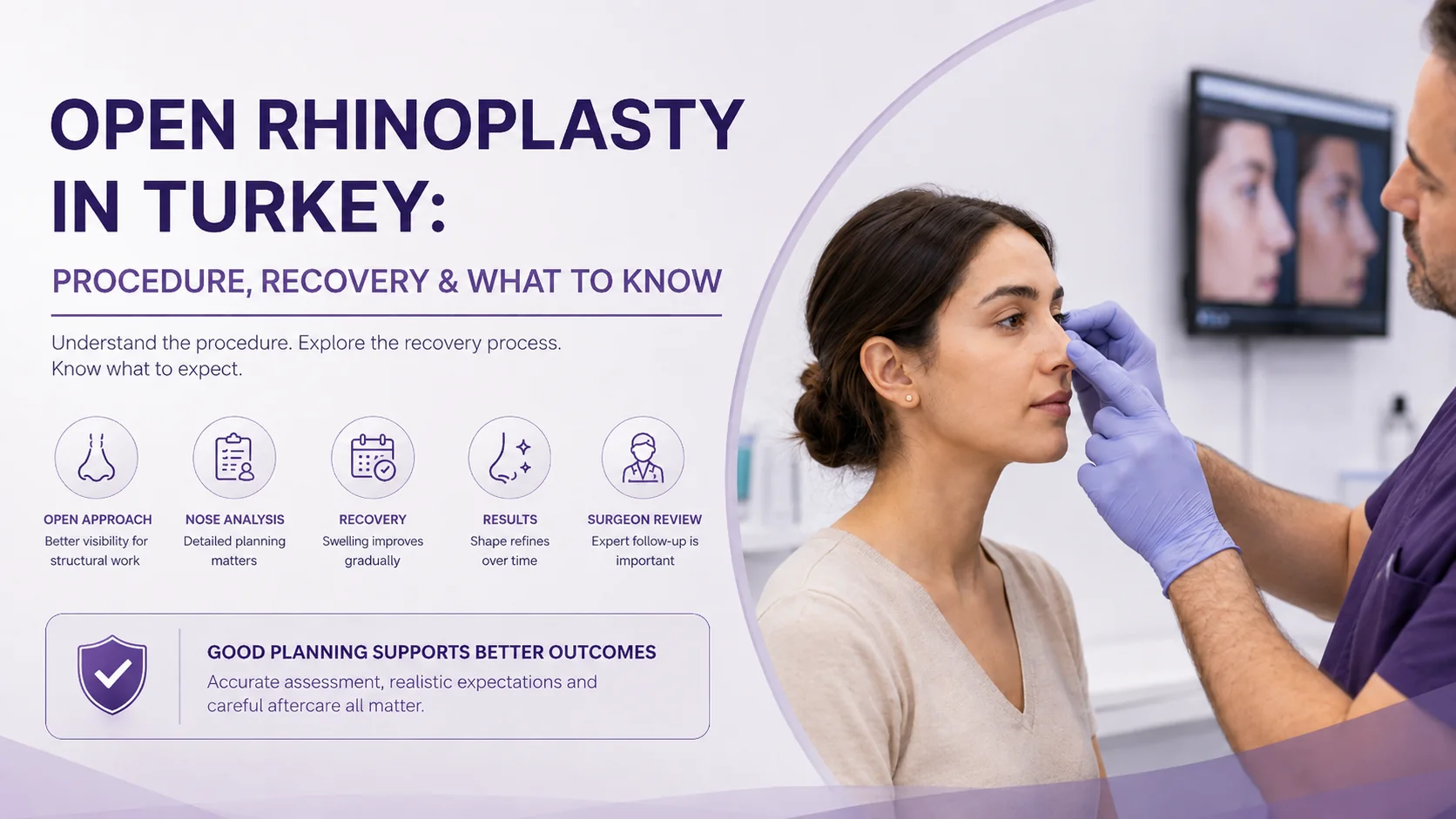
Most visible recovery after open rhinoplasty happens in the first two to three weeks, while the nose continues to refine for up to a year. Recovery varies between individuals, and the timeline below is a general guide rather than a guarantee.
First Week
During the first week the external splint stays on and the nose feels blocked and tender. Swelling and bruising around the nose and under the eyes are common, and are usually most pronounced in the first two to three days before starting to ease. Rest with the head elevated, cool compresses to the cheeks (not directly on the nose) and avoiding any bump or pressure to the nose are typically advised. The splint is usually removed at the first follow-up, around day seven.
Early Swelling (weeks 2–4)
Once the splint is off, much of the obvious bruising settles over the next week or two, and many patients feel comfortable in social settings within roughly two to three weeks. A good deal of the early swelling resolves in this window — often a large share within the first month — though the nose is still healing underneath and the shape is not yet final.
Returning to Work and Daily Activities
Many people return to desk-based work within about one to two weeks, subject to their surgeon's advice. Light activity is usually resumed gradually, while strenuous exercise, heavy lifting and contact sports are typically avoided for several weeks; contact sports in particular may be restricted for longer to protect the healing framework. Glasses may also need to be kept off the bridge for a period, on surgeon advice.
Longer-Term Healing
Subtle swelling can persist for several months, and the nasal tip is usually the last area to settle — particularly in patients with thicker skin. The nose keeps refining as deep swelling resolves, and the final shape typically settles over about twelve months, sometimes longer in more complex or revision cases. Numbness at the tip can take time to fully return as sensation recovers.
How Long Does Swelling Last After Open Rhinoplasty?
Swelling settles gradually, with most early swelling easing over the first few weeks and subtle swelling sometimes lasting several months. Because the open approach involves lifting the nasal skin, early swelling can be a little more noticeable than after the closed approach, and the nasal tip usually takes the longest to fully settle — particularly in patients with thicker skin. Keeping the head elevated and following aftercare advice can help in the early stage.

How to Choose an Open Rhinoplasty Surgeon in Turkey
Choosing an open rhinoplasty surgeon in Turkey should focus on relevant qualifications, experience with your type of case and the quality of the consultation — not on marketing claims. The surgical approach matters less than the surgeon's judgement and skill, so the priority is finding someone who assesses your nose properly and explains their reasoning.
Useful factors to weigh include:
Appropriate medical qualifications and registration
Experience relevant to your specific needs (for example tip work, structural or revision cases)
A thorough consultation that assesses your anatomy and goals
A clear explanation of why a particular approach is recommended
Realistic discussion of what can and cannot be achieved
The hospital or facility context and anaesthesia arrangements
Aftercare and how follow-up is handled once you return home
Clear communication, especially across languages and distance
For the broader treatment and travel journey — consultation, staying in Turkey, and aftercare logistics — see rhinoplasty in Turkey.
Questions to Ask During Your Consultation
A good consultation should leave you clear on the plan. Useful questions include:
Why are you recommending an open approach for my case?
What specific changes are you planning to make?
Will cartilage grafts be needed, and if so, from where?
What can realistically be achieved, and what are the limits?
Where will the incision be, and how is the scar likely to heal?
What does recovery look like, and when can I travel home?
How is aftercare handled once I return to my home country?
What are the main risks in my particular case?
