
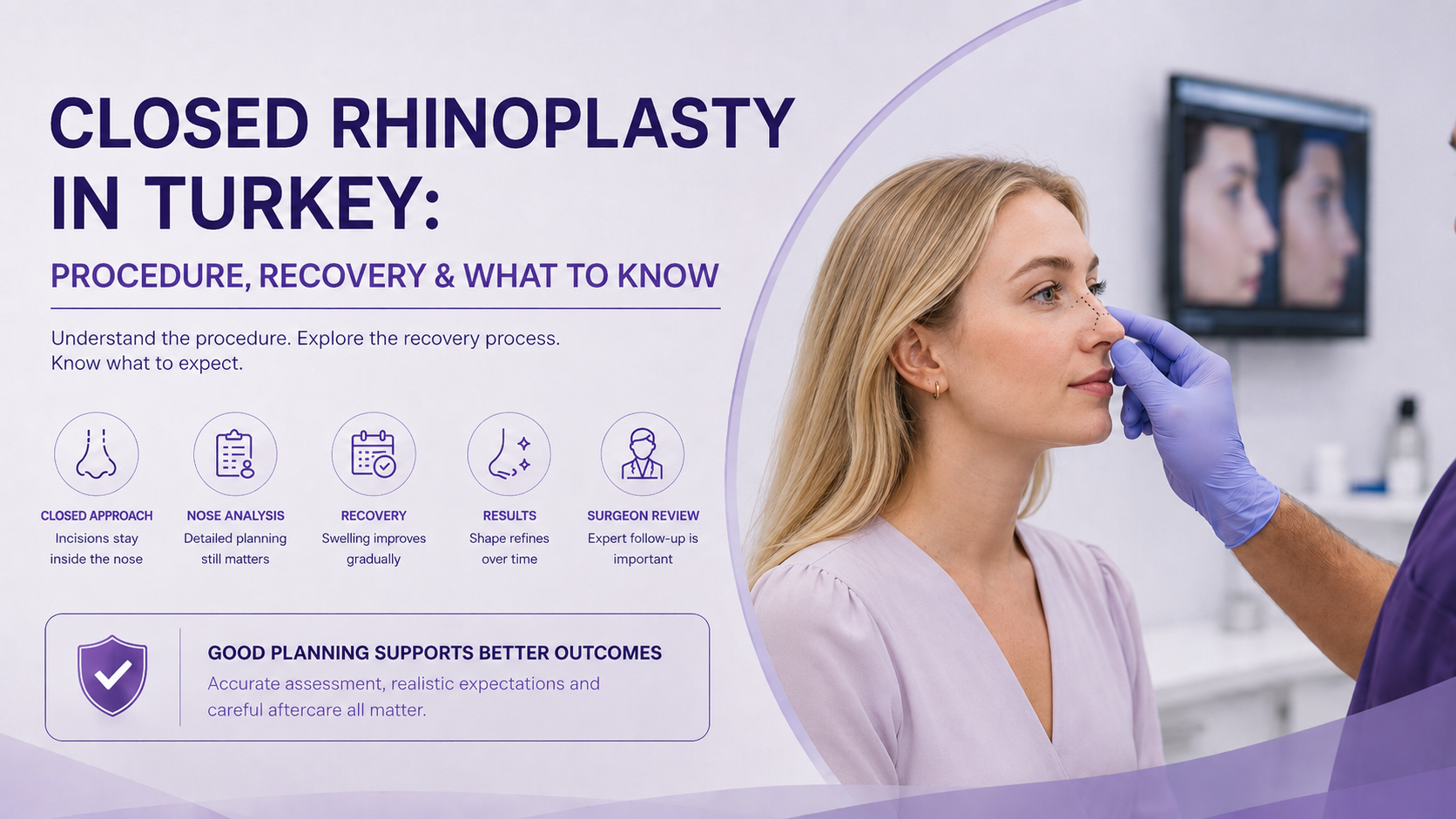

Closed Rhinoplasty in Turkey: Procedure, Recovery and What to Know

Closed rhinoplasty, also called endonasal rhinoplasty, is a nose-reshaping approach in which all the incisions are made inside the nostrils. It is often chosen for refinements where the existing nasal structure is largely satisfactory. This guide explains what closed rhinoplasty is, how the endonasal approach works, when a surgeon might recommend it, what the recovery involves, and what international patients should consider when researching closed rhinoplasty in Turkey — including a clear-eyed look at the common “scarless” and “faster recovery” claims.
Closed Rhinoplasty in Turkey: Procedure, Recovery and What to Know

Table of Contents

Dr. Placeholder Name
Medically Reviewed
Reviewed by Op. Dr. Ömer Aşkıner — Board-Certified Plastic Surgeon

Explore Your Rhinoplasty Options

Get personalized guidance and discover what your rhinoplasty in Turkey could look like.
Please enter a valid phone number.

Key Takeaways

  • Closed rhinoplasty is performed through incisions inside the nostrils (endonasal access), with no incision across the columella.

  • It does not leave an external columellar scar — but “no external incision” is not the same as “no healing”, and it is not accurate to call it scarless surgery.

  • It can suit selected aesthetic and functional corrections, such as bridge refinement, hump reduction and some tip work.

  • The surgeon works with more limited direct visibility, so the approach relies heavily on experience and is not ideal for every case.

  • Recovery and swelling vary; the approach is not automatically faster than open rhinoplasty for every patient.

  • Neither closed nor open is universally better — the right approach depends on individual assessment.

What Is Closed Rhinoplasty?

Closed rhinoplasty is a nose-reshaping technique in which all incisions are made inside the nostrils, so there is no external cut across the columella. Working through these internal openings, the surgeon reshapes the underlying bone and cartilage. It is one of two main approaches; the other is the open (external) technique, which adds a small incision across the columella.

Closed rhinoplasty is also known as endonasal rhinoplasty; “endonasal” simply means that the surgical access is through the inside of the nose, without an external columellar incision. You may see the two terms used interchangeably on clinic websites.

The defining feature of the closed approach is that the nasal skin is not lifted off the framework as fully as in the open technique, which keeps more of the soft-tissue connections intact. For a full explanation of the alternative approach, see open rhinoplasty in Turkey.

How Does Closed Rhinoplasty Work?

Closed rhinoplasty works by making incisions inside the nostrils, reshaping the bone and cartilage through those openings, and then closing the incisions internally. The procedure is normally performed under general anaesthesia. Reported operating times vary by complexity, commonly from around one to three hours. The main stages are outlined below at an educational level.

Internal Incisions

The surgeon makes incisions within the lining inside the nostrils. Because these are internal, no cut is made across the columella and there is no external columellar scar. Different internal incision patterns exist; a standard approach works through the cartilage, while a “delivery” technique can expose the tip cartilages more fully when more detailed tip work is needed.

Accessing Bone and Cartilage

Working through the internal openings, the surgeon reaches the nasal framework. Compared with the open approach, the direct view is more limited, so the surgeon relies more on tactile feedback and experience. This is one reason the closed approach is often described as technically demanding.

Reshaping the Nasal Framework

With access established, the surgeon can refine the bridge, reduce a hump, adjust the tip and, where needed, use controlled bone techniques such as osteotomies. Cartilage can be reshaped, and in many cases sutures or grafts can still be placed through the closed approach, depending on the plan.

Closing the Internal Incisions

Once reshaping is complete, the internal incisions are closed, usually with dissolvable sutures, so nothing needs removing externally. A splint is typically applied to the bridge to support the new shape while it settles.

Closed rhinoplasty access through internal nostril incisions to reach the nasal framework.

Preservation and Ultrasonic (Piezo) Techniques

Preservation rhinoplasty and ultrasonic (piezo) instruments can be used with a closed approach in selected cases, but neither is exclusive to closed rhinoplasty — both can also be used with the open approach. They are worth understanding if you are researching a more modern, tissue-sparing option, but they are techniques and tools chosen for the case, not a separate operation.

What Preservation Rhinoplasty Means

Preservation rhinoplasty aims to reshape the nose — particularly a dorsal hump — by repositioning the natural bone and cartilage rather than removing and rebuilding the bridge. Instead of taking the hump down and reconstructing the profile, the surgeon lowers the existing framework using a controlled technique (commonly called push-down or let-down). Because the natural bridge is kept, the skin drapes over the original contour, which can help preserve natural profile lines in suitable cases.

How Piezo (Ultrasonic) Instruments Fit In

Piezoelectric (ultrasonic) instruments vibrate at a frequency that cuts bone precisely while largely sparing soft tissue, cartilage and the nasal lining. “Ultrasonic rhinoplasty” refers to the piezo tool being used, not a separate operation — it is one part of the surgical plan, and it can be used within either preservation or structural techniques, and with either the open or closed approach.

Who Preservation Techniques May Suit

Preservation and piezo techniques are often discussed for patients with smaller to moderate dorsal humps and good skin quality. They are not suitable for every nose, and a surgeon assesses breathing as well as shape. As with any technique, suitability depends on individual anatomy and goals rather than on the label alone — and the current evidence base for preservation techniques is still developing.

What Can Closed Rhinoplasty Address?

Closed rhinoplasty can address bridge contour, dorsal humps, projection and rotation, mild to moderate asymmetry, selected tip concerns and some functional issues. What can be achieved depends on your individual anatomy and goals, and not every concern is best treated through the closed approach.

Area

What the surgeon may assess

Nasal bridge

Bone and cartilage contour

Nasal tip

Shape, projection and support

Septum

Alignment and structural role

Breathing

Possible functional concerns

Nasal bones

Width and shape

Previous surgery

Existing anatomical changes, if applicable

Key nasal structures that may be assessed during closed rhinoplasty.

Who May Be Suitable for Closed Rhinoplasty?

Suitability for closed rhinoplasty depends on individual assessment, but the approach is often discussed for patients needing mild to moderate refinements with a largely satisfactory nasal structure. A surgeon recommends the closed approach when the planned changes are well-suited to internal access and do not require the fuller exposure of the open approach — a clinical judgement based on your anatomy and goals, not a fixed rule.

Factors that may point toward a closed approach include:

  • Mild to moderate changes, such as bridge refinement or hump reduction.

  • A generally good existing nasal structure that needs enhancing rather than rebuilding.

  • A preference to avoid an external incision, where the case allows it.

  • Selected tip work that can be achieved through internal or delivery techniques.

Because the surgeon works with more limited visibility, cases that need extensive tip reconstruction, large amounts of grafting or correction of significant asymmetry may be better suited to the open approach. A thorough consultation is essential before deciding, and rhinoplasty is generally not performed until facial growth is complete.

Patients who have had previous nasal surgery are a special case: altered anatomy and scar tissue can make internal access harder, so a closed approach is not always possible. That situation is covered under revision rhinoplasty in Turkey. If you want a direct side-by-side of the two approaches, see open vs closed rhinoplasty.

Preparing for Closed Rhinoplasty

Preparing for closed rhinoplasty mainly involves following your surgeon’s pre-operative advice, which commonly covers medications, smoking and general health. Your surgeon and clinic will give you specific instructions; the points below are the ones most patients are asked about.

  • Smoking and nicotine: nicotine can impair healing, so surgeons usually ask patients to stop for a period before and after surgery.

  • Blood-thinning medications and supplements: some medicines and supplements may need pausing beforehand, but only on your surgeon’s advice — never stop prescribed medication without checking.

  • General health and honesty about history: share your full medical history, allergies and any previous nasal surgery so the plan is safe and realistic.

  • Fasting before general anaesthesia: you will be told when to stop eating and drinking before the operation.

For the wider international-patient logistics — travel, accommodation and timing — see rhinoplasty in Turkey.

Advantages of Closed Rhinoplasty

The main potential advantages of closed rhinoplasty are the absence of an external columellar incision and less disruption of the soft tissue, which may support recovery in selected patients. These are potential benefits in suitable cases, not guarantees for every patient.

  • No transcolumellar incision, so no external columellar scar.

  • Less disruption of soft-tissue connections, because the skin is not lifted as fully.

  • Possible recovery advantages in some patients, though this varies with the extent of surgery.

  • Preservation of certain support structures in suitable cases.

Limitations and Considerations

The main limitation of closed rhinoplasty is more restricted direct visibility, which makes complex structural work and extensive grafting harder through this approach. This is why surgeon experience matters so much, and why the closed approach is not automatically the right choice for every nose.

  • More limited direct exposure than the open approach.

  • Greater reliance on the surgeon’s skill and tactile feedback, as changes are made with less direct visualisation.

  • Harder for complex tip work or extensive grafting, where fuller access may be needed.

  • Not always suitable for revision or significantly altered anatomy.

Does Closed Rhinoplasty Leave a Scar?

Closed rhinoplasty does not leave an external scar on the columella, because all the incisions are made inside the nostrils — but that is not the same as “scarless surgery”. The internal incisions still heal, and every surgical wound forms scar tissue as part of normal healing; the difference is that this healing happens inside the nose where it is not visible from the outside.

This distinction matters because “scarless” is one of the most common marketing phrases used for the closed approach. It is more accurate to say the closed technique avoids the small external incision used in open rhinoplasty in Turkey, rather than that it avoids scarring altogether. The key point is simple: no external columellar scar is not the same as no scar tissue.

Closed Rhinoplasty Recovery

Most visible recovery after closed rhinoplasty happens in the first one to two weeks, while the nose continues to refine for several months and up to about a year. Recovery varies between individuals and depends on how much work is done, so the timeline below is a general guide rather than a promise.

First Week

A splint is usually worn for around the first five to seven days and removed at a follow-up; some surgeons apply a second, shorter splint afterwards. Swelling and bruising around the nose and eyes are common early on and tend to peak in the first couple of days, and the nose feels congested. Rest with the head elevated and avoiding pressure on the nose are typically advised. International patients should confirm whether splint removal and the first follow-up will take place before they are cleared to travel home.

Swelling and Bruising

Some patients experience relatively contained early swelling and bruising, because the skin is not lifted as fully as in the open approach. This is not guaranteed, though. It is not accurate to say the closed approach always heals faster or swells less — swelling depends on the extent of surgery, whether bone work is involved and how each person heals. Early visible swelling usually eases over the first few weeks, while the nasal tip, particularly in thicker skin, is usually the last area to settle.

Returning to Work and Daily Activities

Many people return to desk-based work within roughly one to two weeks, subject to their surgeon’s advice. Strenuous exercise and contact sports are usually avoided for several weeks to protect the healing nose.

Longer-Term Healing

Subtle swelling can persist for months, and the nasal tip is often the last area to settle. The final shape typically emerges over several months, and can take up to around a year to fully refine.

General stages of swelling and recovery following closed rhinoplasty.

Closed Rhinoplasty Aftercare

Good aftercare in the early weeks protects your result, and the basics are simple: support healing, avoid pressure on the nose and follow your surgeon’s specific advice. The points below are general and commonly recommended; your clinic’s instructions always take priority.

What to Do During Early Recovery

  • Keep your head elevated, including while sleeping, for the first couple of weeks

  • Use cool compresses around the eyes (not directly on the nose) to ease swelling

  • Take prescribed medication as directed and attend your follow-up

  • Protect the healing skin from strong sun during early recovery

What to Avoid

  • Blowing your nose for the first week or two (follow your surgeon’s timing)

  • Resting glasses on the bridge until cleared, often around four to six weeks

  • Strenuous exercise, heavy lifting and contact sports for several weeks

  • Smoking or nicotine, which can slow healing

  • Knocks or pressure to the nose, and anything that risks a bump

These are technique-relevant basics; for a fuller recovery and travel guide, see rhinoplasty in Turkey.

When to Contact Your Surgeon

Most closed rhinoplasty recoveries are straightforward, but you should contact your surgeon or seek medical care promptly if you notice signs that are not part of normal healing. Because international patients recover mainly at home, it is important to know these signs and to have a clear line of contact with your clinic before you travel back.

  • Heavy or continuous bleeding that does not slow with gentle pressure.

  • Signs of infection, such as spreading redness, warmth, pus or a fever.

  • Severe or worsening pain that is not controlled by your prescribed medication.

  • Sudden or unusual swelling that gets worse rather than better after the early days.

Can Cartilage Grafts Be Used in Closed Rhinoplasty?

Yes — cartilage grafts and support sutures can often be placed through the closed approach, though extensive or complex grafting can be harder without fuller exposure. Whether grafting is used depends on the individual plan, not on the approach alone. For more detailed tip grafting, surgeons may use a delivery technique that exposes the tip cartilages more fully while still working through internal incisions.

So “closed” does not mean “no grafts”. Where a case needs major structural rebuilding — for example after previous surgery — a surgeon may prefer the open approach; those cases are discussed under revision rhinoplasty in Turkey.

Can Closed Rhinoplasty Improve Breathing?

Closed rhinoplasty can sometimes address breathing concerns alongside reshaping, depending on the cause and the individual plan. For example, a deviated septum can often be corrected through internal access. When reshaping and functional correction are combined, the procedure may be planned as a septorhinoplasty. Whether breathing can be improved depends on the underlying issue, so it should be assessed individually rather than assumed.

Risks and Limitations of Closed Rhinoplasty

Like any surgery, closed rhinoplasty carries risks, and outcomes vary between individuals. A qualified surgeon should explain the risks relevant to your specific case at consultation. The points below are general and educational, and do not replace individual medical advice.

  • Prolonged swelling, particularly at the tip and in thicker skin.

  • Bruising and temporary numbness around the nose, which usually settle over weeks.

  • Asymmetry or an uneven result; minor asymmetry is common early in healing, but a persistent difference may need review.

  • Breathing changes, which can improve, stay the same or occasionally be affected, depending on the case.

  • Difficulty achieving complex changes through limited access, which may occasionally mean the plan needs adjusting.

  • Infection or delayed healing, as with any operation, which is why aftercare and follow-up matter.

  • The possibility of further surgery if the result does not fully meet the agreed goals.

Choosing a Closed Rhinoplasty Surgeon in Turkey

Choosing a closed rhinoplasty surgeon in Turkey should focus on relevant qualifications, genuine experience with the closed technique and the quality of the consultation. Because the closed approach demands precise work through limited access, the surgeon’s judgement and experience matter more than the label of the technique.

Useful factors to weigh include:

  • Appropriate medical qualifications and registration

  • Genuine experience with closed/endonasal rhinoplasty for cases like yours

  • A clear explanation of why a closed approach suits your anatomy

  • Honest discussion of what can and cannot be achieved this way

  • Understanding of any functional (breathing) concerns

  • The hospital or facility context and anaesthesia arrangements

  • Aftercare and how follow-up is handled once you return home

  • Clear communication, especially across languages and distance

For the broader treatment and travel journey, see rhinoplasty in Turkey.

Questions to Ask During Your Consultation

A good consultation should leave you clear on the plan. Useful questions include:

  • Why are you recommending a closed approach for my anatomy?

  • What changes are realistically possible this way?

  • Would cartilage grafts or tip sutures be needed?

  • Are any breathing concerns being addressed?

  • What would make you switch to an open approach during surgery?

  • What does recovery look like, and when can I travel home?

  • How is aftercare handled once I return to my home country?

  • What are the main risks in my particular case?

Main factors reviewed during a closed rhinoplasty consultation.

Closed Rhinoplasty in Turkey for International Patients

International patients considering closed rhinoplasty in Turkey should focus on the parts of the journey affected by the technique — recovery before flying and aftercare at a distance. It is worth confirming how long the surgeon advises staying before travelling home and how follow-up will be handled remotely, since you will complete most of your healing in your home country.

General travel, accommodation and patient-journey planning is covered on the main rhinoplasty in Turkey page, so this page focuses on the approach rather than the full trip.

Closed Rhinoplasty Results (Before & After)

Before-and-after photographs are a useful way to judge a surgeon’s closed-rhinoplasty work — when compared fairly, using the same angles, lighting and enough healing time. If you have a gallery, view our rhinoplasty before-and-after results. Before-and-after images show previous patient outcomes and cannot predict or guarantee another patient’s result.

How Much Does Closed Rhinoplasty Cost in Turkey?

Closed rhinoplasty does not have a fixed price simply because it uses an endonasal approach — the cost depends on the overall treatment plan. Factors that influence price include case complexity, the surgeon, the hospital, any bone or cartilage work, functional correction and what a treatment package includes. It is not accurate to assume the closed approach is automatically cheaper than the open approach.

For general price ranges, package inclusions and budgeting, see rhinoplasty cost in Turkey. If your case involves previous surgery, revision-specific pricing is covered under revision rhinoplasty cost in Turkey.

Closed vs Open Rhinoplasty: Brief Context

The fundamental difference is incision placement: closed rhinoplasty uses incisions entirely inside the nostrils, while open rhinoplasty adds a small incision across the columella to lift the skin for fuller visibility. The closed approach avoids an external scar; the open approach offers more direct access for complex work. Neither is universally better — the right choice depends on your anatomy, goals and the surgeon’s assessment.

For a full side-by-side of scarring, swelling, recovery and how surgeons choose between them, see open vs closed rhinoplasty.

Frequently Asked Questions

What is closed rhinoplasty?
Closed rhinoplasty is a nose-reshaping technique in which all incisions are made inside the nostrils, so there is no external cut across the columella. The surgeon reshapes the bone and cartilage through these internal openings. It is also called endonasal rhinoplasty.
Is closed rhinoplasty the same as endonasal rhinoplasty?
Yes. “Endonasal” means “within the nose”, so endonasal rhinoplasty and closed rhinoplasty generally describe the same approach: surgery through incisions inside the nostrils, without an external columellar incision.
Does closed rhinoplasty leave a visible scar?
It does not leave an external scar on the columella, because the incisions are inside the nostrils. However, it is not truly “scarless” — the internal incisions still heal and form scar tissue inside the nose, where it is not visible from the outside.
Is closed rhinoplasty painful?
Most patients report discomfort rather than severe pain. The nose feels congested and tender in the first days, with swelling and some bruising, but pain is usually well managed with the medication your surgeon prescribes. The blocked-nose sensation often bothers people more than actual pain, and it eases over the first week or two.
Who may be suitable for closed rhinoplasty?
It is often discussed for patients needing mild to moderate refinements with a largely satisfactory nasal structure. Complex tip reconstruction, extensive grafting, significant asymmetry or many revision cases may be better suited to the open approach. Suitability requires individual assessment.
How long does closed rhinoplasty recovery take?
Most visible recovery happens in the first one to two weeks, with the splint usually removed after about a week. Subtle swelling can last months, and the nose can keep refining for up to a year. Recovery varies from person to person.
How long should I stay in Turkey after closed rhinoplasty?
Most patients stay until the splint-removal check so the surgeon can confirm early healing before they fly — our surgeon typically advises [X–Y days; insert Medart’s verified protocol]. Flying too soon is generally discouraged, so confirm the recommended waiting time with the clinic before booking a return flight.
Does closed rhinoplasty cause less swelling?
It can involve relatively contained early swelling in suitable cases, because the skin is not lifted as fully. But this is not guaranteed — swelling depends on the extent of surgery, any bone work and individual healing, so the closed approach is not automatically faster or less swollen than the open approach.
Can cartilage grafts be used in closed rhinoplasty?
Yes. Grafts and support sutures can often be placed through the closed approach, sometimes using a delivery technique for tip work. Extensive or complex grafting can be harder without fuller exposure, so it depends on the individual plan.
Can preservation or ultrasonic (piezo) techniques be used with closed rhinoplasty?
Yes, in selected cases. Preservation rhinoplasty repositions the natural bone (push-down or let-down) rather than removing and rebuilding the bridge, and piezo is a precise bone-shaping tool. Neither is exclusive to the closed approach — both can also be used with the open approach — and suitability is decided at assessment.
Is closed rhinoplasty better than open rhinoplasty?
Neither approach is universally better. The right choice depends on nasal anatomy, treatment goals, structural requirements and the surgeon’s assessment. For a full comparison, see the open vs closed rhinoplasty guide.

Medical Sources

This article draws on peer-reviewed literature and clinical guidance. Key sources include:

  1. Guilarte & Malzone, closed piezo-assisted preservation rhinoplasty cohort (734 patients), Aesthetic Surgery Journal, 2025 — reported revisions mainly relating to dorsal contour adjustments. [Confirm full citation before publishing.]
  2. Systematic reviews of preservation rhinoplasty techniques (dorsal, soft-tissue and lateral-crural preservation), noting heterogeneity and a still-developing evidence base.
  3. Comparative reviews of open vs closed rhinoplasty outcomes, which do not establish one approach as universally superior for patient outcomes.
  4. Kilavuz et al., columellar incision suture study, Facial Plastic Surgery, 2017 (referenced on the open rhinoplasty page).

Medical Disclaimer

This article provides general educational information about closed rhinoplasty in Turkey. It does not replace individual medical assessment. Suitability for closed rhinoplasty depends on your individual anatomy and treatment goals, and the surgical approach should be determined through professional evaluation. Risks, recovery and outcomes vary between patients. Technique selection should be discussed with an appropriately qualified surgeon.

Contact Us!

Please enter a valid phone number.